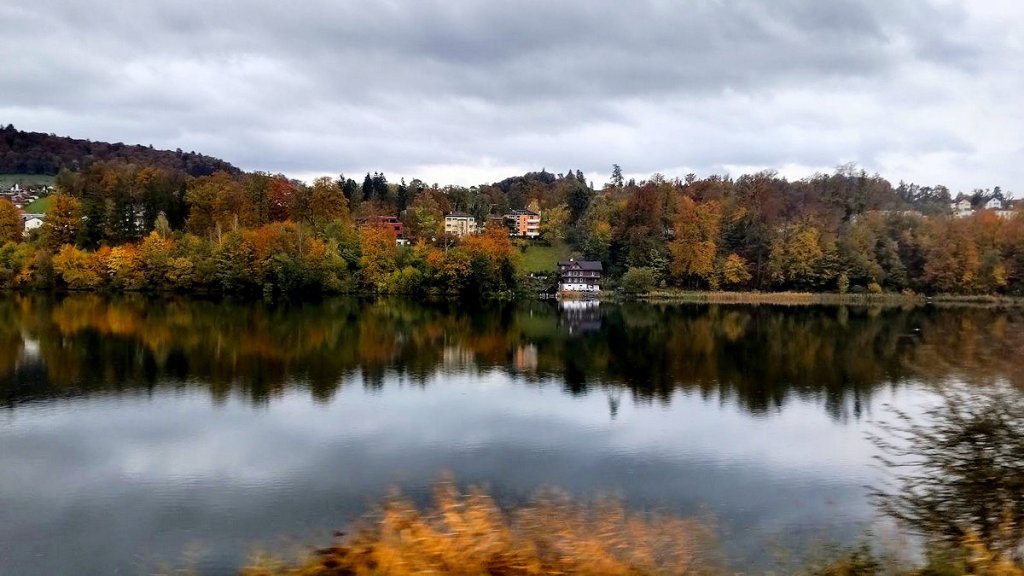
One cool thing about studying in Tokyo is that your classmates are often the free-spirit types who love hopping around the world. This time, I caught up with my soon-to-be PhD buddy in Switzerland. We last hung out in Tokyo, and now, four years later, we meet up again in the middle of Europe.

I planned this trip in a complete haste. It was the wrong season, a busy time for my friend preparing for her PhD defense, and a hectic period for me with work and fatigue from my daily routine. Guess what? It turned out great. The one thing I did right was booking the SBB travel pass early, which covered unlimited public transport and train rides across Switzerland, along with free museum tickets. This took immense stress off my shoulders, as I could travel anywhere on a whim.
Zurich

Now, let’s get down to business. My first destination was the magnificent Zurich. This time, I explored the German-speaking part of Switzerland. Zurich boasts a history that spans over 5,000 years, with the initial settlers establishing their homes along Lake Zurich. The Romans arrived in 57/58 BC, laying the foundation for the Turicum customs station. In the 4th century, a castle was erected on Lindenhof, playing a crucial role in the city’s expansion. From the modern Lindenhof, you can enjoy a splendid view of the city, including the two impressive cathedrals, Grossmünster and Fraumünster, along with the clock of Saint Peter’s church.


During the Early Middle Ages, Charlemagne’s discovery of Zurich’s patron saints led to the establishment of Grossmünster and Fraumünster. Zurich thrived as a trade hub and pilgrimage site. Upon entering the crypt of Grossmünster, you’ll encounter an imposing statue of King Charles himself, provided you can tolerate the scent of moisture and (is it actually?) lingering decay. Don’t forget to visit the aula and the garden, showcasing Romanesque architecture and some notably intriguing sculptures (yes, there are buttocks involved).


The 16th-century Reformation, spearheaded by Ulrich Zwingli (you’ll come across plaques bearing his name everywhere), left an indelible mark on German-speaking Switzerland. Zurich became a magnet for religious refugees and evolved into a center for the textile industry. The Peace Treaty of Westphalia in 1648 granted the Confederation its independence. IIn the late 18th and 19th centuries, Zurich transformed from a trade city to an industrial hub. Post-World War II, the service sector dominated, and former industrial districts became trendy areas. I’ve spent hours just wandering around the alleys of Münstergasse. Personally, I find the east side of the river Limmat more appealing than the west. On the east side, amid high-end art and clothing shops, you can also come across the Opera, Lenin’s house, and the cultural hotspot Cabaret Voltaire.


Zurich consistently ranks as a city with the highest quality of life globally in recent years. It is an ideal place for engineers (my friend is currently a researcher at none other than ETH Zurich). She describes her life as striking the perfect work-life balance, even though daily activities may lean towards the more subdued side. The Polyterrasse of the ETH main building has an excellent (and free) view of the city, as well as a great and cheap restaurant at the top. As for the Polybahn funicular to get down to the river level? Eh, it wasn’t worth the ticket fare.


Don’t expect hardcore clubbing or intense nightlife here. When I visited Langstrasse, often considered the ‘wild and dangerous’ street of the city, it seemed more like a serene park compared to the vibrant scenes in Athens, Tokyo, and Barcelona. Nevertheless, there are still a couple of captivating live performances; we enjoyed a fun brazilian night with indie guitars at Moods. You can grab a bite at the nearby Zentralwäscherei Space, which looks like a squat but is actually a sponsored project by the city.


Another quirky option is the sailor-themed El Lokal, while for traditional meat+beers or cheese fundue, you have to find your way to Zeughauskeller and Adler’s Swiss Chuchi. In all my years in Japan, I was convinced that Rösti was a swedish dish. I stand corrected and realized it is a swiss national dish, so don’t forget to try it.


There are several outstanding museums in the area that I unfortunately didn’t have time to explore. However, my local friends highly recommend visiting the Kunsthaus, the Landesmuseum, and the Swiss Finance Museum. Another option, especially if the weather isn’t favorable, is to take a trip to Baden for a relaxing, not-so-warm soak in the hot springs. I’m quite particular about my hot springs – anything below 42°C just doesn’t cut it for me.
Luzern

Lucerne is positioned on the Reuss River at the outlet of Lake Lucerne. Named after the 8th-century Benedictine monastery of St. Leodegar, the city emerged from a nearby fishing village. In 1291, the city faced a shift in governance when it was purchased by Rudolf IV of Habsburg, against the citizens’ desire for independence. It played a leading role in the Catholic cantons during the Reformation and served as the papal nuncio’s seat from 1579 to 1874. Today, the city is a major tourist resort, attracting visitors with its scenic environment, mild climate, and accessibility by road and rail.


The most prominent sightseeing spot is the Chapel bridge, Kapellbrücke, which was originally built in the 1300s. The old town on the right bank features well-preserved 14th-century town walls, quaint alleys, the Fontana, and notable buildings such as the old town hall and St. Peter’s Chapel. The clock tower Museggmauer at the city walls is closed from November until spring, so keep that in mind for your visit.


If you look toward the mountains, you will be taken aback by Mount Pilatus, a mountain massif overlooking Luzern. The highest peak, Tomlishorn, reaches 2,128.5 meters. I missed the chance to visit it now, because I’m not so well-versed in navigating snow, but it should be amazing during summer. Mt. Pilatus and nearby Mt. Rigi and Mt. Titlis are in my to-do list for next spring, when the snow melts and visibility improves.


Adjacent to the main train station, the Culture and Convention Centre designed by Jean Nouvel enhances the city’s architectural appeal. Other andmarks include the Lion of Lucerne monument, the Bourbaki Panorama and the Glacier Garden. The Lion monument intrigued me, revealing that it stands as a tribute against the backdrop of the French Revolution. Symbolizing the demise of the Swiss Guards alongside King Louis XVI and Marie Antoinette, it marked the end of the mercenary collaboration between the French Empire and Switzerland. A benefactor sponsored this sculpture to honor the massacred guards and express disapproval of the revolution and pro-monarchy sentiments. Others are displeased that a monument was built to honor Swiss citizens dying for a foreign monarchy.

On the other hand, Bourbaki Panorama is a large, circular panoramic painting depicting the Franco-Prussian War in 1871. The Swiss, in accordance with their policy of neutrality, interned the French soldiers after they suffered a great defeat.

The Glacier Garden in Lucerne is a unique natural and historical attraction located in the heart of the city. The erratic blocks of boulders are proof of the ice age and were caused by water flowing underneath the ice. The garden features other attractions, such as a traditional Swiss house, a journey to a rocky underworld, a marvelous oriental mirror maze and the great Sommerau terrace.

Bern

The city of Bern was founded in 1191 by the Dukes of Zähringen. Joining the Swiss Confederation in 1353, it became the capital in 1848. The city boasts a well-preserved old town situated along the picturesque Aare River. I watched the sun set from the Rosengarten and then headed down to Nydegg Bridge. The winding alleys of the old town had a complete different feel compared to Zurich and Luzern. The arched pavements of Kramgasse hosted a lot of art shops; I guess art is a prime commodity for a financial hub. In the old city you can find the 15th century Cathedral, the clock tower Zytglogge and Einstein’s house. I got myself some excellent dry gin from Matte Brennerei, located in Bern, one of the best gin’s I’ve ever tried.


Schloss Laufen am Rheinfall
On my last day, I was faced with two options; either visit Mt. Rigi and see nothing due to snow, or visit Rhine falls and see nothing due to the foamy water. I chose the latter. Laufen Castle is perched majestically on a rock above the largest plains waterfall in Europe, at the source of Rhine river.

This specific waterfall of High Rhine is the most powerful in Europe. It is 150 m wide and 23 m high with an average water flow of 600 m3/s in the summer. There are a couple of attractions around here, but I chose to do one thing. I walked next to the falls and then went to the opposite side at Schlössli Wörth and got myself a coffee and a cake while watching the falls and listening to the uproar.


If you want to see even more water, lake Konstanz is not so far from here. Fun fact: the watchmaker IWC and mapper Garmin are based right here, in nearby Schaffhausen.
Bonus: Richterswil
The Americans have altered so many traditions in our collective mindset! Why did it take me so long to find out that Helloween is St Martin’s day celebrated on November 11th (11/11), instead of that Oct 31st mimicry? As it turns out, Saturday, November 11, was the perfect day to experience the local festival in Richterswill, a charming village near Zurich.


In line with local traditions, instead of pumpkins, people carve lanterns out of turnips, which shine bright with a reddish hue. These lanterns, the Räbeliechtli, are used to adorn houses, which, for this special day, open their gardens to visitors. Local associations craft elaborate floats using turnips, parading them around the village. The festivities conclude with everyone indulging in Gluewein made with the season’s first wine, accompanied by sausages and potatoes from street vendors.


Epilogue
People told me that Switzerland is exactly like Japan. Turns out, it is not. Swiss style reflects some influence from the rest of Europe, so the trains are not as precise, recycling not as strict and utter discreetness not as common as in Japan. More importantly, Tokyo is a city that never sleeps, with an amazing nightlife. I could easily compare Zurich with Kanazawa or Nagano, though. The optimal set were trains, nature, tranquility and high life standards meet.
Tell me what you thought of the trip in the comments. If you liked this blog, spread the word to your friends. So you don’t miss any article, you can follow me on Facebook or instagram. See you next time!
Want to read more?

Roadtrip in Austria (part 1): New year’s in Salzburg
Salzburg is a classy city in west Austria, extremely close to the border with Germany and Munich, with…
Συνέχεια
Roadtrip to Gifu: Kanazawa challenging El Dorado (Pt. 3)
On a gloomy day, we woke up early and headed to Kanazawa, in Ishikawa prefecture. It was my…
Συνέχεια
Memories from December (Berlin-Dresden-Meissen-Leipzig-Prague)
I know it’s spring, but I want to share some photos from my December trip. If you ever…
Συνέχεια belleelene