Much to my surprise, the classy island of Aegina has become quite a popular option for tourists visiting from Athens for a day trip. Today, we’ll talk about my failed attempt to traverse the island from west to east and learn what YOU should do, to make your day trip a success.

Located just 27 kilometers from Athens, Aegina is easily reachable by ferry. Ferries to Aegina’s Chora (a common word describing the main town of an island) depart regularly from Piraeus, Athens’ main port. The journey takes approximately an hour, depending on the type of ferry. During the summer season, the eastern port of Agia Marina is also operating, making the island even more accessible.

Despite being so close, I’ve been trying to visit Aegina for some 10 years now. I guess it’s a case of living close enough to add the place in the “can do whenever but do never” bucket list of ideas. The island was the location where the story of one of my favorite teen books (Ο ΘΗΣΑΥΡΟΣ ΤΗΣ ΒΑΓΙΑΣ – ΖΩΡΖ ΣΑΡΗ) was taking place. Moreover, the great Hellenistic temple of Aphaia is located in the eastern part of the island.


Aphaia is associated with the Cretan goddess Diktynna or Britomartis. According to Greek mythology, King Minos of Crete pursued Britomartis, who escaped by jumping into the sea and was saved by fishermen who brought her to Aegina. There, she was again pursued and took refuge in Artemis’s sacred grove, disappearing with the goddess’s help. Britomartis, linked to Artemis, was later worshiped as Aphaia, meaning “the invisible one.” The locals found a statue in her place and established a sanctuary, which led to the construction of a temple in the early 5th century BC. Although the temple is well-preserved to this day, its sculptures and decorations are displayed in Munich’s Kunstareal in Germany.

Anyway, the other day I came across a trail traversing the island from side to side, including a stop at the temple of Aphaia. Since I am both a mythology nerd and a hiking aficionado, it was a dream come true. I packed my backpack with plenty of water, snacks, a hat, and tons of sunscreen, I rang two friends and took the early boat. Keep in mind this was a sunny day in March, so I definitely do not recommend this for the summer. A lot of foreign tourists seem to underestimate the barren land and the scorching sun of the Greek islands from May onwards.

Since it was still winter season, we reached the western main port. We had to book our return tickets immediately since the boat tends to get full, even during an uneventful March weekend. I imagine that the situation gets even worse during the summer. The town is pretty with all its neoclassical two-storied buildings in a row, hugging the port. From there, we moved to the general direction of Kypseli. I thought the name sounded funny, since Kypseli is currently the new hot neighborhood in Athens, the target of much of the ongoing gentrification. Anyway, we passed the outskirts of Kypseli, and after a steep hill, we reached a meadow overgrown with plenty of green, yellow, and purple shrubs. There were only a few trees scattered around, as expected for the Aegean islands. My friend playfully jokes that the tallest plant that ever grows on the Cyclades islands is oregano.


Soon, we noticed a road going downhill and came across the monastery of St. Nektarios. I was completely unaware, but it seems that it is a major attraction, drawing visitors year-round for pilgrimage and healing. Visitors can see the holy well of Saint Nektarios and stay in guest accommodations. The church is definitely new and a bit over the top, but I guess that means that the religious business is going well.


I was more interested in the abandoned village of Paliachora (meaning literally old town). It is a medieval village built in the 9th century and served as the island’s capital until 1826. It is located behind and above the hill of Saint Nektarios, towards the island’s center. I would assume it was an excellent location to build a capital, hidden from the keen eyes of the pirates of that era. However, when the pirate threat subsided, residents moved back to coastal areas, leading to Palaiochora’s abandonment and gradual collapse. I could see that the remaining structures had mixed with the landscape and were barely discernible even from the nearby monastery.


Palaiochora was once known as the village where “every bell has its priest” because it had 366 churches (one for each day of the year) and 800 houses. Today, only 38 Byzantine-style churches remain, some in good condition, worth visiting for their history and preserved frescoes. Due to the many churches, Palaiochora gives off vibes reminiscent of Mystras in the Peloponnese. At the hilltop one can find the remnants of the Venetian-built castle (constructed in 1654). Although the trail is marked with red turtles, the footpath is not well-preserved and you should definitely wear proper hiking shoes, or even use your hands for support from time to time.


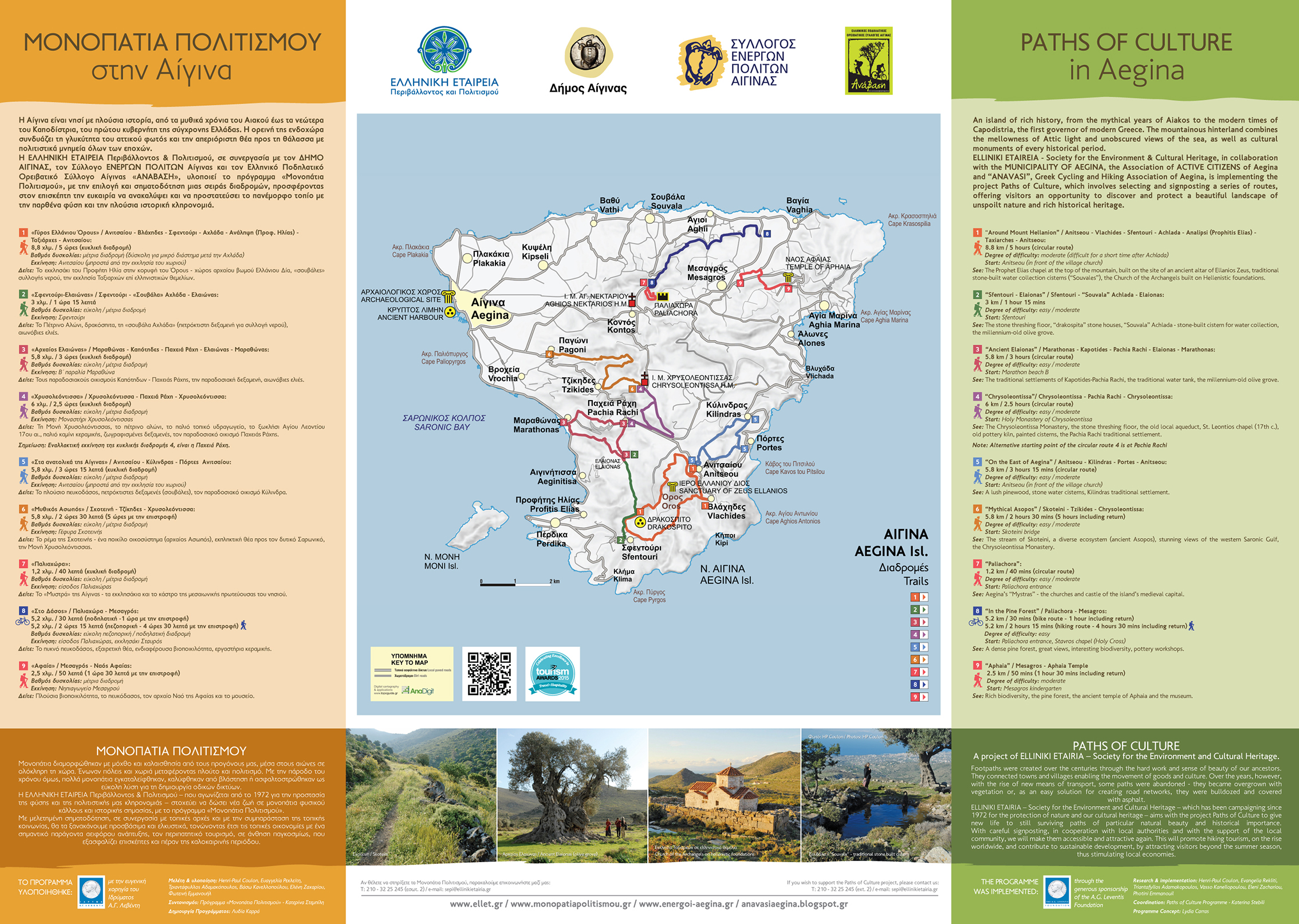
And here’s where I made a mistake. After reaching the church of Saint Makrina, I saw no path to go downhill. It would be doable, although a bit hard for my friends who were inexperienced. Plus, I was unsure of whether there would be access to the road, or if the farmlands down under would be fenced off. That meant that I had to do a large detour and it wouldn’t be feasible to reach the temple of Aphaia that day. I understood that this specific trail was supposed to be traversed from east to west and uphill, not the opposite as I did. Anyway, a map of official paths is available here.

My backup plan was to turn back to the entrance of Palaiochora and follow the car road to the sea, to Souvala port. We headed directly to the beach for a quick swim, despite the water being still chilly, as expected. This area is called Loutra (meaning baths) or Therma (meaning hot) because of the therapeutic water of a sulfuric hot spring.


In order to reach our return boat on time, we had to call for a taxi, since buses were not operational yet. The setting sun cast a wonderful light on the old buildings. Fish and fruit vendors were out and about around the port. We had dinner at one of the many taverns and walked a bit towards the temple of Apollo, to observe a solitary pillar standing alone.


Before wrapping up this post, I’ll add some more mythological details about the island. It is named after the nymph Aegina, a daughter of the river god Asopus and the nymph Metope. According to myth, Zeus, the king of the gods, fell in love with Aegina and abducted her. He took her here and the island was renamed in her honor. Aegina bore Zeus a son named Aeacus, one of the most respected and just rulers in Greek mythology. After his death, he became one of the judges of the dead in the underworld, alongside Minos and Rhadamanthus. His rule brought prosperity to the island, and he was deeply revered by its inhabitants.


However, Zeus’ official wife, Hera, of course found out about his affair with Aegina. Extremely offended as she was, she sent a plague to depopulate the island. In response to the prayers of Aeacus, Zeus transformed the island’s ants into men, thus creating the Myrmidons (meaning ant-people), a loyal and fearless tribe. These warriors later followed their king Achilles, the grandson of Aeacus, to the Trojan War. So Aegina is the motherland of the mighty Achilles, although his kingdom was by then based in southern Thessaly, due to his father being exiled after committing the sin of killing his brother. I am guessing that the origin of this myth has something to do with residents who probably had to immigrate due to the scarce resources of the island, since it doesn’t have a river, only some small ravines.

If you are in the mood for this 15km hike, you can follow the path Aigina -> agios nektarios ->Palaia Chora -> Vathy on alltrails. The original trail that I wanted to follow is Temple of Aphaia – Agios Nektarios Monastery – Aegina town. Be extremely wary about the scorching sun and the lack of water or shadow along the trail. You can read more hiking posts under the tag hiking. If you liked this article, share it with your friends. You can also follow this blog, and follow me on Instagram or Facebook, to never miss a post. Until next time!

Read more:

Hiking in Greece: Hunting for statues in Naxos Island
I know, it’s probably a cliché thought in the heart of winter, but let’s take a stroll back…
Keep reading
Hiking the Summer Isles: Milos’ Sulfur Mines
Were you aware that the Greek islands hold a treasure trove beyond bustling beaches and picture-perfect poolside moments…
Keep reading
Hiking in Greece: Mt Taygetus
Standing at a balcony observing the north face of Mount Taygetos, I felt ancient whispers calling me to…
Keep reading belleelene