It’s October, yet somehow a wildfire is crackling away in western Corinth, just a stone’s throw from the majestic peaks of Helmos and Ziria. The world sure has changed. We’ve already talked about Ziria, now it’s time to visit Helmos and learn why its snow is commemorated in Greek folk songs.

Besides the two ski resorts (Kalavrita and Ziria ski centres), these ranges have managed to stay pristine and untouched, covered with a lush fir forest. Since 2009, the mountainous mass of Helmos and the Vouraikos river gorge have been a protected area, designated as a “National Park”. You would have thought that this is a wonderful thing, but alas. These mountains are so “useless”, according to a Greek newscaster, because they’ve been spared from the scourge of development and lack roads. If you can’t profit from the forest, what’s the point of keeping it in the first place?

Let’s begin at the beginning. The Aroania Mountains, more commonly referred to as Helmos, form a striking mountain range in the northern Peloponnese, straddling the border between the Achaia and Corinthia prefectures. Its highest peak at 2.355 meters rises close to Kalavryta, a town of remarkable beauty, yet one that bears the weight of a tragic history in more recent times. On December 13, 1943, during the German occupation of Greece, a Nazi squad executed the entire male population of Kalavryta and razed the town in what is now remembered as the Kalavryta Massacre. This atrocity was carried out in retaliation for the success of Greek resistance forces operating in the area, many of whom had sought refuge in the surrounding mountains.


The name Aroania comes from the word Aornos, which for the ancient Greeks referred to Hades (a-ornos, meaning “the place not even inhabited by birds”). On the other hand, similar to Ziria, the name “Helmos” is of Slavic origin. While some researchers argue that it refers to a “snowy mountain,” others have noted that the related Slavic word хълм means “hill.” There is also a theory suggesting an Arvanitic origin, with the stem helm meaning “poison.” According to ancient Greek mythology, the river Styx originates here, continuing its flow into the underworld. Styx was one of the Oceanid nymphs, who resided in her palace in Tartarus, guarded day and night by sleepless dragons. Her children were Power, Violence, Zeal, and Victory. When a god wished to take an oath, they would swear by the waters of Styx—the most binding and powerful oath of all. However, if a living being drank from the waters, they would die, and any metal dipped into the river would melt. The hero Achilles gained his godly powers when his mother, Thetis, dipped him in the river Styx, though she had to hold him by the heel to do so. As a result, his heel was the only part of his body that didn’t touch the water and remained vulnerable to weapon attacks.


The mountain of Helmos usually receives heavy snowfall, enough to sustain the ski centre. However, local folk songs have long celebrated the enduring nature of its snow, often linking it to the heartache of love. One such folk song, part of the Lianotragouda tradition, poignantly reflects the trials and sufferings of love.
ΚΑΪΜΟΙ ΚΑΙ ΒΑΣΑΝΑ ΤΗΣ ΑΓΑΠΗΣ
Αδύνατό ειναι μια καρδιά σαν πληγωθή να γιάνη, μοιάζει δεντρί που μαραθή και πλιο καρπό δεν κάνει.
Δίχως χιόνια χιονίζουμαι, δίχως βροχαίς βροχιούμαι, δίχως μαχαίρια σφάζουμαι, όντας σε συλλογιούμαι.
Εγέρασαν τα πάθη μου σαν του Χελμού το χιόνι,
π’ όσο να λειώση το παλιό καινούργιο το πλακώνει.
Sufferings and Trials of love
It is impossible for a wounded heart to be healed, it looks like a tree that dried up and bears no fruit.
Without snow I get snowed on, without rain I get rained on, without knives I am slaughtered, when thinking of you.
My sufferings aged like snow on Helmos, as soon as the old snow melts, the new one covers it once more.


To reach the high peaks of the mountain, you have two main options: ascending from the north via the ski center or approaching from the east through the wild gorge of Styx. The latter route is accessible by hiking Achilles’ Path from Mesorrougi village—a stunning yet challenging trail, where hiring a local guide is recommended. (On a side note, if you ever end up in Mesorrougi, be sure to visit the tavern of Ntinos.) We opted for the easier route, starting from the ski center. Our hike began with a steep vertical climb, moving up from one level of the resort to the next. Eventually, we turned right and started following an auxiliary dirt road for a short distance.


One of Helmos’ well-known peaks is Neraidorachi at 2,340 meters, which forms a vertical slope that dominates the eastern side of the mountain. I adore its name, which describes a ridge where nymphs are said to reside. The Helmos Observatory is located around this peak, chosen for its exceptionally low levels of light pollution—one of the best spots in Europe—and the fact that the telescope often sits above the clouds. The first steps toward establishing the observatory were taken in 1997, and it was officially inaugurated in 2007, when it was handed over to the scientific community. The Aristarchus reflecting telescope was installed here, named after Aristarchus of Samos, an ancient astronomer who first proposed that the center of the universe was the sun rather than the Earth.


The highest peak of Helmos is called Psili Korfi, which literally translates to “tall peak.” The mountain is surrounded by Durduvana (a Slavic word for the rose plant), Mainalon, Erymanthus, and Ziria. In its northern foothills lies Lake Tsivlou, while an alpine lake forms periodically from melting snow at an altitude of around 2,050 meters, near the springs of Styx. The view from the summit is breathtaking, with mountain peaks being visible for as far as you can see. In June, the entire hike to the summit and back took around 3.5 hours, with a slow pace.


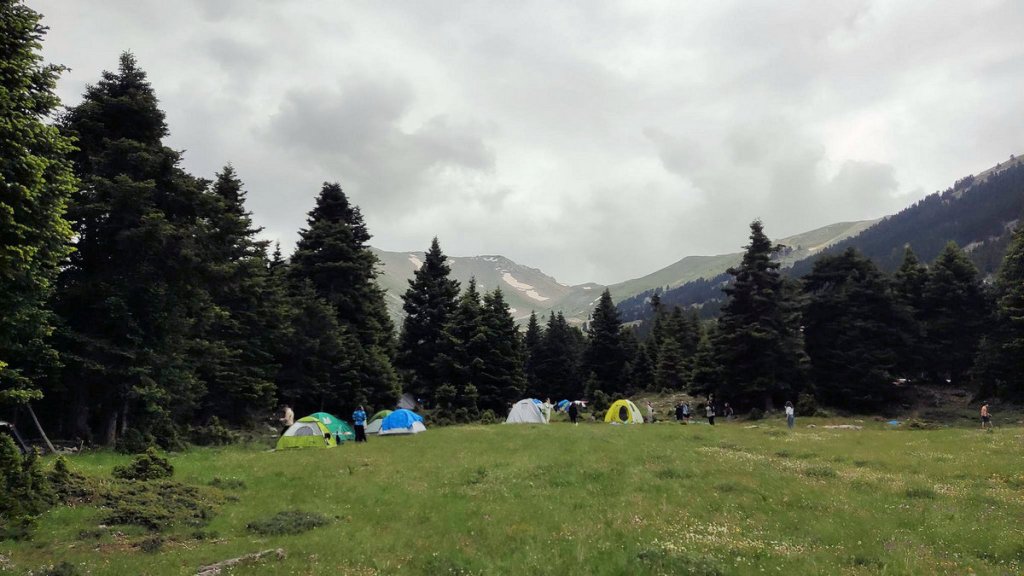
As we know, climate change is wreaking havoc on the seasons. Helmos no longer gets as much snow as it once did, prompting the ski center’s management to seek alternative sources of income. In 2023, they introduced an annual music festival on the ski grounds to replace the shortened winter season with a series of summer events. Hundreds of young people set up tents around the maintenance buildings, settling in for a three-day weekend.


However, the weather on Helmos can be unpredictable. Massive clouds often gather, and sudden heavy rains can come out of nowhere, especially in the afternoons, without warning. This was what we experienced on the first iteration of the Helmos mountain festival. Like clockwork, every day around 4 p.m., a downpour would drench our tents and belongings. At that time, most of the eventgoers (including us) were cramped inside the central cafeteria building, waiting for the rain to stop. Luckily, the rain always stopped by 6 p.m., just in time for the preparation of the live performances. We’d hang out our sleeping bags and clothes to dry, then spend the evening in front of the music stage, singing and dancing under the starry sky, fueled by copious amounts of local tsipouro. Drunk and happy, we’d crawl back to our tents, only to do the same all over again the next day.


Once again, I am grateful to Utopia adventures for taking me along Helmos mountain. If you want to experience this mountain yourself, you can follow the trail Helmos Mountain Loop on alltrails. Be extremely wary about the scorching sun during the summer and the lack of potable water or shadow along the entire part of the trail. You can read more hiking posts under the tag hiking. If you liked this article, share it with your friends. You can also follow this blog, and follow me on Instagram or Facebook, to never miss a post. Until next time!

Read more:

Hiking in Greece: Hermes playground at Mt Ziria
The Ziria mountain range is home to the second tallest peak of the Peloponnese. Taygetus is first, Ziria…
Keep reading
Hiking in Greece: Mt Taygetus
Standing at a balcony observing the north face of Mount Taygetos, I felt ancient whispers calling me to…
Keep reading
Hiking in Greece: The dragon lake of Tymfi
Today, I’m sharing my experience hiking in the Pindus Mountains and visiting the Dragon Lake of Tymfi. The…
Keep reading belleelene
