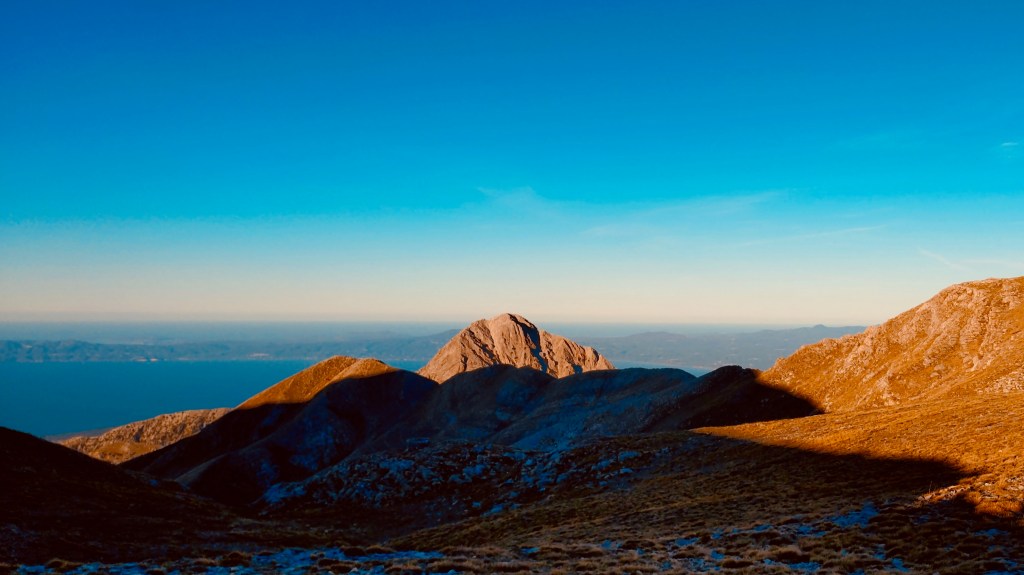
By now, I think Parnon and Taygetus are the mountain ranges I’ve visited most. A true-born Peloponnesian maiden, I am. So bear with me as we head south once more. When you pass the gates of Taygetus and turn left toward the peak of Profitis Ilias, you might notice a solitary peak directly ahead of you. Ever wondered what it looks like up close?

The Taygetus mountain range boasts several prominent peaks beyond its main summit. Historically, it was known as Pentadaktylos (Five-fingered), a name inspired by the five principal peaks in its central region: Spanakaki (2,024m), an Unnamed peak (2,229m), Sidirokastro (2,228m), Athanati Rachi (2,340m), and Profitis Ilias (2,405m). Traversing the entire Pentadaktylos range is one of the most demanding yet rewarding undertakings, but perhaps that attempt is best saved for another time. For now, let us turn our attention to Chalasmeno, the peak that stands opposite Athanati Rachi and Profitis Ilias.


This side of Taygetus is most easily accessed from the western side of Kalamata. To ensure an early start, we prepared for an overnight camp, cramming ourselves into three trucks. The journey was nothing short of grueling. I endured over an hour of bouncing along a dirt road, with all my camping gear piled on top of me. Yet, despite the discomfort, there’s something undeniably exhilarating about a truck ride. Eventually, we arrived at our refuge for the night: the church of Panagia Kapsodematousa. This church, dedicated to the Virgin Mary, carries a rather unusual name. The epithet “Kapsodematousa” translates to “Branch-burner,” referring to the tradition of burning branches after the harvest season.


According to local legend, a peculiar event led to this name. Long ago, a giant turtle appeared in a nearby village. The pious and somewhat naive villagers, unsure of its significance, sought the wisdom of the old village sage. Annoyed by their endless questions and their habit of ignoring his advice, he sarcastically declared, “It’s a sign of blessing.” Taking his words literally, the villagers organised a celebratory festival. They even decorated the turtle’s shell with a burning candle. Feeling uncomfortable by the flame, the turtle wandered into the nearby bushes, inadvertently setting off a fire. The blaze spread rapidly, consuming the entire harvest. Since then, the church’s name was changed from “Panagia the Blessed” to “Panagia the Branch-burner,” a lasting reminder of the incident. The villagers began teaching their children never to play with matches near the fields, warning them that “the river and the fire know no borders.”


The Ridomo and Koskaraka Gorge stretches over 25 kilometers, narrowing to just two meters at its tightest point. Beginning in the tall peaks of Taygetus, it descends all the way to the beach of Sadava, where it meets the sea. At the site of Panagia Kapsodematousa, three separate streams converge. Nearby, the now nearly abandoned villages of Ridomo and Pigadia remain the most inaccessible settlements in the entire Peloponnese. The ideal time to explore the gorge is from late summer to early autumn, when the vibrant hues of fall foliage look their best. Our hike began along an unmaintained dirt road, a relatively new addition, built just a year or two ago to support the needs of local shepherds. As we progressed, we even passed by a solitary house tucked into the forest. Early autumn is also walnut season, and my companion kept slowing down to gather freshly fallen walnuts along the way.


As the path ascended, we were treated to brilliant views of the surrounding peaks. On one side, we spotted Tragovouni (1,908m), and later, Neraidovouna (2,031m). The latter, with its steep inclines and challenging terrain, is famed as one of the most demanding winter hikes in the region. At its summit lies a stone marker from the Roman era, historically used to define the border between the prefectures of Lakonia and Messinia.


After navigating a relatively steep ascent, we arrived at a critical decision point. To the left lays Kaki Tikla, a rugged scramble that ultimately leads to the summit of Profitis Ilias. Our mountain guide exclaimed “Every time I make it through the Tikla, I curse myself for going there in the first place.” So do as you please with that piece of information. But alas, to the right stands Chalasmen itself. You are lucky if you see the peak clearly, for it is usually covered by low-laying clouds.


Now, there are various explanations about the name Chalasmeno Vouno, which means “broken mountain” in greek. One explanation mentions that this is due to the many thunders and strikes that this peak receives. The few burnt trees along the path serve as testament to this, but the peak is located well above the forest zone. Another local legend tells of a misunderstanding among the villagers, who mistakenly believed this peak to be the tallest on Taygetus. They attempted to construct a shrine dedicated to Prophet Elias at this spot, but, as if by divine intervention, the stone wall kept falling every night. The divine destruction seemed to signal that this was not the rightful location for the shrine. Eventually, the villagers understood the error and made the shrine – which now stands (kinda) – on the nearby summit.


The final 200 meters of the ascent to Chalasmeno’s peak involve a scramble comparable in difficulty to the louki of Mytikas on Mount Olympus. Having attempted both, I must admit that while this scramble was less steep, it felt longer and more exhausting. The ascent is guided by blue markers painted on the rocks, and as you climb, the calming view of Kalamata Bay unfolds to your left. Reaching what seems like the summit, you are tricked by a small preliminary peak—only to realise the real one awaits in front of you. At last, the true summit comes into view, marked by a red iron post and a box for the log book, an addition by the mountaineering club of Kalamata. The weather changes fast on the peak, with clouds giving way to clear skies and a some more new clouds again and again.


From the top you can enjoy unobstructed view of the Profitis Ilias peak and the entire mountain range of Taygetus. There is also clear view to both the bay of Lakonia and the bay of Messinia. I like to use Peakvisor when I come back from a hiking trip in order to make sense of what I admired.


After marvelling at the view for a long while, I wrote the name of belleelene on the logbook and started the long way of the return. Believe me when I say that you have to be extremely careful during the descent, because that’s when the majority of accidents happens. You’ve reached the goal of the top, you are tired and bored, you start cracking jokes and before you know it, you fall on your knees. Just keep in mind that if you get down in one piece, you can enjoy the sunset at the lovely seafront of Kalamata.


Credits go to Orsalia, Spyros and Nikos for some of the photos in this post. Once again, I am grateful to Utopia adventures for taking me along Chalasmeno and Ridomo gorge. If you want to experience this mountain yourself, you can follow the Xalasmeno and Rintomo gorge loop on alltrails. Be extremely wary about the scorching sun during the summer and the lack of potable water along the entire part of the trail. You can read more hiking posts under the tag hiking. If you liked this article, share it with your friends. You can also follow this blog, and follow me on Instagram or Facebook, to never miss a post. Until next time!

Read more:
Hiking in Greece: Mt Taygetus
Standing at a balcony observing the north face of Mount Taygetos, I felt ancient whispers calling me to…
Keep reading
Mt. Olympus’ Tallest Peak: Mytikas
Last time, I took you along my journey to Mt. Olympus and the Plateau of the Muses. But…
Keep reading
Hiking in Greece: Lepida Gorge
In Greece, there’s a saying that goes, ‘If I don’t praise my house, it will fall on my…
Keep reading belleelene