
In my favourite Greek cult classic movie, a pair of revolutionary agents carry the nicknames “Parnassos” and “Giona”. I introduced Mt Parnassos not long ago, so now it’s his girlfriend’s, Giona, turn.

It was lazy and cool May, and I had decided to keep my weekends for myself and chill at home. Alas, I can’t trust myself in making promises like these. My cool group of friends will always appear with a mountain suggestion. So, weekend in Giona it is. We departed from Athens extremely late, and barely managed to sit for dinner at the Taverna Miranda in the village of Kastellia. It wouldn’t be possible to drive the dirt road to a decent camping spot at night, so we found a semi-acceptable location to quickly setup tents at Vryzes. Oh, how I’ve always wanted to be waken up by horses and cows sniffing my tent (#not).


On the next morning, we packed up quickly and started our adventure. Giona is the tallest mountain in central Greece and the fifth tallest overall in the country. Its characteristic feature is the pyramid-shaped peak, reaching 2,510 meters. It is located in the middle of other mountains of similar height, namely Parnassos, Vardousia, and Oiti. It is mentioned in many songs describing what is called the “battle of mountains”, often clashing with Olympus and Liakouras (Parnassos), like this one or this one. It is not as rich as the rest in water sources, but we found a couple of running springs in late May while we walked.


Do you remember the revolutionary movie couple I mentioned at the beginning? This again is no coincidence. The rocky summits of central Greece played a crucial role as refuges for revolutionary forces, both during the Greek War of Independence in 1821 and later during the German Occupation in World War II. Our approach started at Mnimata, which, as it turns out, are the tombs commemorating the revolutionaries of Giona. We followed the dirt road for a while with the car and eventually parked near a gorge, where we set up camp for our second night. The official trail starts a bit higher and goes through Kedros towards Vathia Lakka or Gionolakka, directly under the pyramid. The ascent was not as steep and quite enjoyable at the first part that was covered in firs. After reaching the plateau of Vathia Lakka, then the rocky terrain gets a bit steeper. We met a few groups of hikers almost out of breath under the scorching sun. When we reached the peak of the pyramid, the 360 degrees view of the surrounding peaks was breathtaking, even with a dusty sky (yes, sand from the Sahara desert was visiting Greece again on that specific weekend). We had a plan to make a loop towards Plativouna, but retreated. One of our friends made a blunder by picking the wrong hiking boots, so we could do nothing but retreat.


This is still one of the most sparsely populated areas in Greece, with no villages in the mountain’s interior. The origin of the name Giona must be slavic, however one of the ancient nicknames of the mountain was “Dis-chimeron”, which means “with harsh winters”. It’s easy to imagine the snowcapped ridges. The area is so remote and desolate that even the POA refuge is considered one of the most difficult to access in Greece. I remember our teacher at mountaineering school speaking with a heavy heart about how hard it was to transfer building materials and provisions every time repairs were needed.


In the past, the mountain was also known as Aselinon Oros, which means “Moonless Mountain”. According to myth, the lunar goddess Selene met her lover, a shepherd named Endymion, in a cave on this very mountain every month. Thus, the world was left moonless at regular intervals. For Selene to continue enjoying the company of her mortal lover, she pleaded with Zeus to grant him eternal sleep, so that she could visit him forever. I’m not sure how Endymion came to be associated with Giona — canonically the “moonless cave” refers to Mt Lakmos in Asia Minor — but nevertheless, local sources seem to promote this version of the myth.


The mountain produces a magnificent landscape by combining large alpine meadows with steep cliffs. Apart from being a hiker’s favourite, Mt Giona is also a real challenge for climbers. The steep slope of Sykia is the tallest in the country (maybe even in the Balkans?) with an altitude difference of 1,100 meters. Many prominent Greek climbers have attempted record-breaking ascents on this beast, though some have also faced serious danger. For hikers who enjoy the rocks, an alternative route is from below Sykia, attempting a scramble via the demanding Karagiannis trail. A second option is via Lazorema, though one should be wary of angry shepherd dogs guarding their flocks.


Here you’ll find my trail recording from Kaloskopi to the peak of Gkiona on alltrails. Make sure to check out the excellent instructions of Olympus Mountaineering. You can read more hiking posts under the tag hiking. If you liked this article, share it with your friends. You can also follow this blog, and follow me on Instagram or Facebook, to never miss a post. Until next time!

Read more:
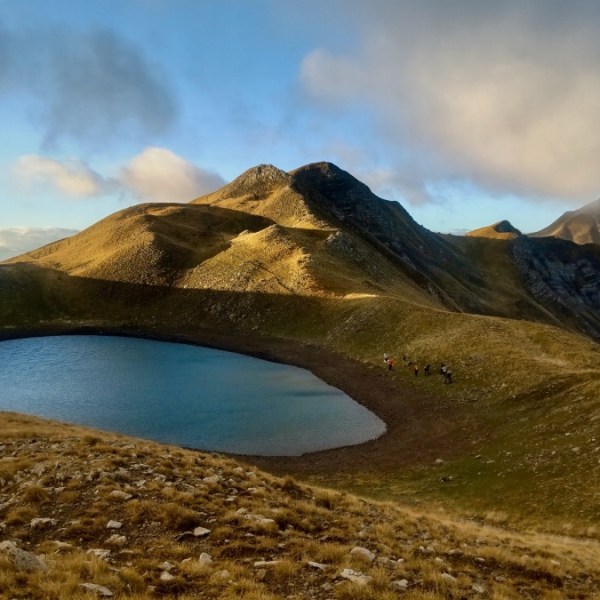
Hiking in Grammos: The north remembers
The name Grammos sounds a lot like the word grammi, which means line. And indeed, this namesake mountain…
Keep reading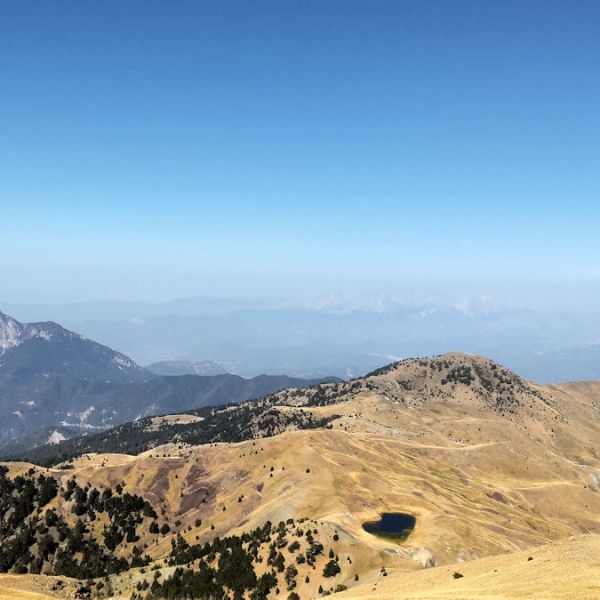
Hiking in Greece: Smolikas finished second
First things come first, but the runner-up also has their charm. After Mt Olympus comes Mt Smolikas, the…
Keep reading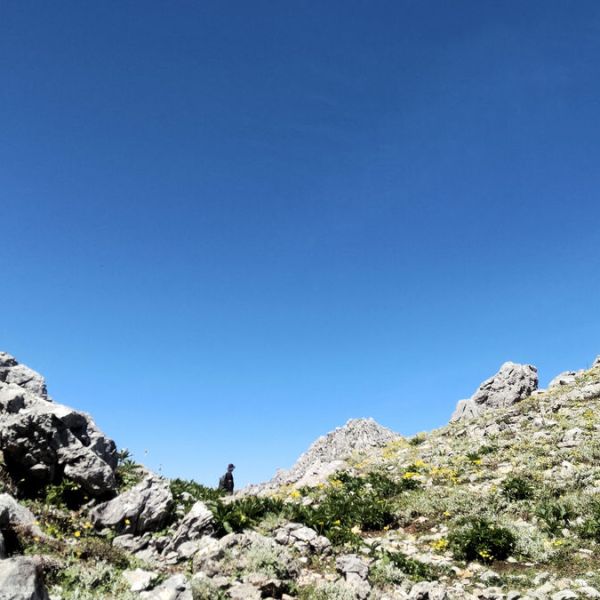
Is Xerovouni actually barren?
There are many peaks around Greece with names like Xerovouni (or Xero-whatever). Xero (pronounced ‘ksero’) means dry and…
Keep reading belleelene