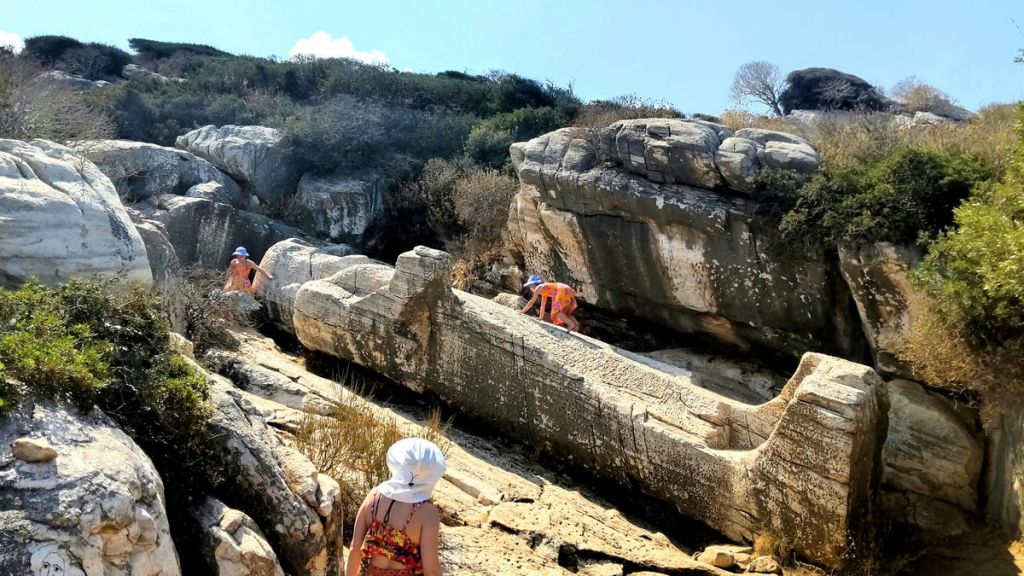
You know what? I’m missing summer already. I know, it’s probably a cliché thought in the heart of winter, but let’s take a stroll back to August in Naxos. We will learn more about Apollo and the Kouros’ statues that look awfully lot like him.

While most visitors flock to the Cycladic Island of Naxos for the renowned beaches like Agia Anna and Agios Prokopis, along with the obligatory selfie at the colossal temple columns of Portara, the average tourist’s tour usually ends there. However, let’s not forget that the tallest mountain peak among all Cycladic isles is Mt Zas of Naxos. Well, it is not so tall, just above a kilometer in height, topping at 1004 meters. The name Zas derives from Zeus, because the king of gods grew up at a cave in this mountain, according to the legend. Ancient relics include an inscription on a rock which states that this is “the mountain of Zeus, the protector of sheep” (yeah, it seems everything in Naxos revolves around sheep and their decorative bells, but shhhh- it’s reason enough for a vendetta).

The connection between Naxos and the Olympians doesn’t stop at Zeus. Dionysus, the god of wine and Zeus’ son from Semele, born from his own calf, chose Naxos as his earthly palace. When Theseus made a pit stop in Naxos on his way back to Athens after defeating the Minotaur, Dionysus decided to keep Theseus’ ally and wife, Ariadne, as his queen.
Now, with this kind of introduction, you might expect me to talk about my hike up Mt Zas. Well, I hate to disappoint, but I didn’t go. It was the end of summer, and my mission was to drink as many cocktails as possible while enjoying the local cuisine. While I did explore the island from one beach to the next and from one ancient temple to another, a proper hike didn’t make it onto my agenda. Instead, I embarked on a nice walk to discover the kouros’ statues that are scattered around the island. Since the landmarks on google maps seem a bit off, make sure to check out my AllTrails map at the end.


We’ll start and end the trail at the tiny, semi-inhabited village of Myloi. Its name comes from the now abandoned watermills that are scattered around. The water canals remain there, making music as the water flows downwards. You can spend some time exploring the watermills, or climb the stone step, heading towards the main road to Kinidaros. Once you reach the ancient aqueduct, follow the trail on your right. Passing the small church of Panagia Fleriotissa, you’ll soon spot a parking lot marking the entrance to the ancient quarries.


Kouros, translating to “boy,” refers to a category of statues portraying male figures in a standard pose—naked, standing with the left leg slightly in front of the other. They are assumed to be taking the form of a young and vigorous Apollo. A Kouros’ female counterpart is a Kore, always dressed and dignified. These statues were prevalent in the 6th century B.C., inspired by Egyptian art, and were often erected at temples or on the graves of notable men as a reminder of their youth. Carved from a single block of marble, an ancient quarry like this one in Flerio is an ideal location to spot a few.


Moving along the trail, you’ll encounter the Kouros of Flerio lying in a field, measuring 6 meters and crafted around 570 BC. The carving appears unfinished, and one of his legs is unfortunately broken. The proximity to the quarry suggests the possibility that the statue broke during transportation and was left abandoned. Less than a kilometer further, the trail leads to the Kouros of the Gorge, appropriately named, with his broken feet by his side. The prevalent belief is that these statues were abandoned due to accidents during quarrying or their removal for delivery, or possibly because an order was canceled due to insufficient funds from the buyer. Naxos’ quarries were among the first systematically developed, contributing to the evolution of arts in ancient Greece.


When you return to Myloi, try to make it so that you have dinner at its single -unnamed- restaurant (it opens at 19:00). There’s no menu, the owner is going to surprise you, according to your preferences. If you’re up for an extended hike, there’s a trail from the second statue that leads to the abandoned castle of Apano Kastro at Ano Potamia.

Alternatively, hop in your car and search for the third and largest Kouros statue. Known as the Kouros of Apollonas or Colossus of Dionysus (we’re not entirely sure which god it represents), it stands at an impressive 10.7 meters and is also unfinished. This one depicts an older man, likely abandoned due to its excessive weight for transportation. Nearby, you can also find the derelict Tower of Agia, with a short path leading to the adjacent church.


If you’re interested in exploring the details of this hike, you can follow the route from Melanes to Flerio and Ano Potamia on AllTrails. Other popular trails are the loop of Mt Zas summit and cave, as well as the one to Apaliros castle. You can read more hiking posts under the tag hiking. If you liked this article, share it with your friends. Have you been to the summit of Mt Zas? Tell me in the comments. You can also follow this blog, follow me on Instagram or Facebook, to never miss a post. Until next time!

Read more:

Hiking in Greece: Mt Olympus, the seat of the gods
The day that you’ve been waiting for, after all those years of reading the hiking posts of a…
Keep reading
Hiking trip to Fukushima: Mt. Adatara
Mt Adatara (安達太良山) is a prominent volcanic peak, a bit closer to Fukushima city. Its name consists of…
Keep reading
Hiking in Greece: Lepida Gorge
In Greece, there’s a saying that goes, ‘If I don’t praise my house, it will fall on my…
Keep reading belleelene