
The plains of Athens are encircled by a group of four mountains. Among them is Mount Pentelicus, the second tallest mountain in Attica, situated northeast of the city center. The quarries of Penteli are famed as the source of the marble used in many classical works of art.

Mount Pentelicus, also known as Pentelikon, rises to a height of 1,109 meters at its summit, Pyrgari. It serves as a natural boundary, separating the Athenian valley from the coastal area facing Evia Island. At its northern foothills lie the plains of Marathon—yes, the very route that inspired the legendary race. The mountain’s prominence and distinctive pyramid-like shape make it a recognizable feature of the Athenian skyline. In ancient times, the mountain was called Vrilissos (or Brilessus), though there is ongoing debate about whether this name actually referred to the Tourkovounia hills in central Athens. Some sources also mention the name Brilettus, linking it to nearby peaks such as Mount Hymettus (pronounced Eemeetos), Lycabettus Hill (pronounced Leekaveetos), and Ardettus Hill (pronounced Ardeetos). The suffix -ettos, of pre-Greek origin, denotes a hill, leading many researchers to argue that the name more accurately describes the lower Tourkovounia hills rather than Mount Pentelicus. Regardless of this historical ambiguity, the suburbs that surround the mountain at its south-west side are now called Old Penteli, New Penteli, Melissia and Vrilissia, because of this association.


The ancient deme (municipality) of Ekali was also located near the mountain. According to myth, Ekali was an elderly woman who provided refuge to the young prince Theseus (the one who killed the Minotaur) during his journey to defeat the infamous Bull of Marathon (another bull, indeed). She pledged offerings to the gods to ensure his safety in this dangerous attempt. Thanks to her support, Theseus successfully overcame the bull. Tragically, upon his victorious return, he discovered that Ekali had passed away. In gratitude, Theseus established a shrine in her honor. Today, the suburb of Ekali is one of the wealthiest areas of Athens, renowned for its lush greenery and serene surroundings.


Mount Pentelicus is distinguished by its rocky, white terrain, complemented by lush pine forests that cover its lower slopes. Numerous ravines originate from the mountain, including the Chalandri Ravine, Rapentossa, and Valanaris. Penteli has always been a favorite excursion spot for Athenians and has been praised by poets and writers. Its wonderful climate was considered a cure for people suffering from tuberculosis. Moreover, from the Byzantine ear onwards, the mountain became a popular Christian hermitage, even being considered the Mt Athos of Attica. The most significant religious monument from the mid-Byzantine period in Penteli is the Monastery of Daou Penteli. At the foot of the mountain, atop the adjacent hill known as “Koufos,” stands the prominent Penteli Observatory, established in 1936.


And now, we can move on to the dark history of Mount Pentelicus. Not far from the observatory, stands the gothic palace of the Duchess of Placentia, often referred to as the “Castello of Rhododaphne.” The Duchess, Sophia Lebrun married Charles Lebrun, Duke of Placentia, who served as an adjutant general to Napoleon I. From this marriage, Sophia had a daughter named Eliza. During the Greek Revolution, Sophia and her daughter actively supported the cause, offering significant financial aid. Later, she embarked on extensive travels through the Near and Middle East in a desperate attempt to find a cure for her daughter, who was suffering from a progressively worsening lung condition, likely tuberculosis. Tragically, Eliza succumbed to her illness in Beirut. Devastated, the Duchess had her daughter’s body embalmed (?) and kept it in her temporary residence in Athens. However, disaster struck when a fire broke out, consuming the residence and the remains of Eliza. After this event, the Duchess underwent profound and unsettling changes in her behavior. She distanced herself from Christianity and turned to Mosaicism, adopting new spiritual beliefs. In this period, she founded a mystical organization that attracted both Greek and foreign members. Among her peculiar convictions was the belief that completing the Castello would foretell her death. As a result, the construction of the Castello, which began in 1841, was deliberately left unfinished when work ceased in 1847 and fell into disrepair for over a century. In her final years, the Duchess lived in near-complete isolation at her temporary residence, the Maisonnette, in Penteli. Some believe that she is still haunting the mountain, grieving for her daughter.

An urban legend with absolutely no historical substance claims that the Duchess was having a romantic relationship with the robber Davelis, who supposedly reached her bedroom at night through the underground passages of his cave, the homonymous Davelis cave. These tales are more plausibly linked to the robber Bibisis, who, ambushed the Duchess and kidnapped her. The incident ended happily and the Duchess, appreciating the fact that the robber did not mistreat her, intervened to have him granted amnesty by the state.


The Cave of Penteli or Cave of the Immaculate Conception or Cave of Davelis is located in the southwest of the mountain at an altitude of approximately 720 meters. It was discovered by accident in the ancient times, during marble extraction. The quarry of the cave is considered the most important in ancient Greece. The cave was an important religious center both during the classical and the during the proto-christian era. It was also considered the operating grounds of the infamous robber Davelis. Over the years, various bizarre things have been reported about the cave, such as metaphysical experiences experienced by visitors. Electromagnetic disturbances, gravitational anomalies, a strong smell of ozone, temporary memory loss, are only some of the claimed effects of the surrounding area. In the 1970s, sounds and light coming from the cave was described as an impact of secret military works for the establishment of a hidden base, causing a great public uproar. Unfortunately, these works caused incalculable destruction to the archaeological site. In the late 80s, urban legends place the cave as the meeting ground for black magic groups, who gathered to perform satanic rituals.


Unfortunatelly, Mt Pentelicus is one of the most traumatized mountains of Attica. From the time of King Otto and onwards, dozens of quarry permits were given thoughtlessly. In the 50s and 60s when marble was in great demand, the quarries created enormous cavities that completely altered the face of the mountain, causing great ecological disaster. Nowadays, the mountain is still being traumatized by uncontrollable urban development. The mountain has degraded as a habitat due to frequently-occurring wildfires. Last August, my aunt had to rush back to Athens from our vacation home, expecting to see her home at the foot of Mt Pentelicus burnt down. Luckily, her house escaped the wildfire, but this wasn’t the case for many houses, trees and animals in the area. Despite that, Mt Pentelicus remains an important peri-urban enclave of impressive biodiversity for the moderate size and condition of the mountain.


Once again, I am grateful to Utopia adventures for taking me along Mt Pentelicus. If you want to experience this mountain yourself, you can follow the Mt Pentelicus map on alltrails. Be extremely wary about the scorching sun during the summer and the lack of potable water along the entire part of the trail. You can read more hiking posts under the tag hiking. If you liked this article, share it with your friends. You can also follow this blog, and follow me on Instagram or Facebook, to never miss a post. Until next time!

Read more:

Hiking in Greece: The funnels of Mt Parnitha
The metropolis of Athens is surrounded by four mountains: Parnitha, Pentelicus, Hymettus, and Aigaleo. Out of these four,…
Keep reading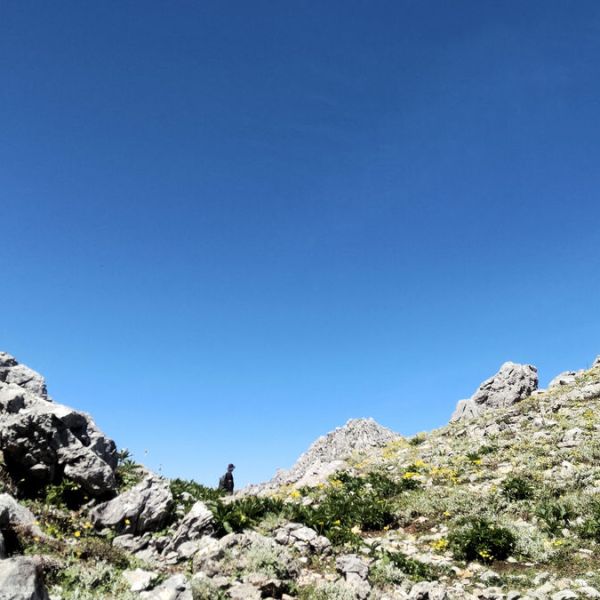
Is Xerovouni actually barren?
There are many peaks around Greece with names like Xerovouni (or Xero-whatever). Xero (pronounced ‘ksero’) means dry and…
Keep reading
My sufferings aged like snow on Helmos
It’s October, yet somehow a wildfire is crackling away in western Corinth, just a stone’s throw from the…
Keep reading belleelene