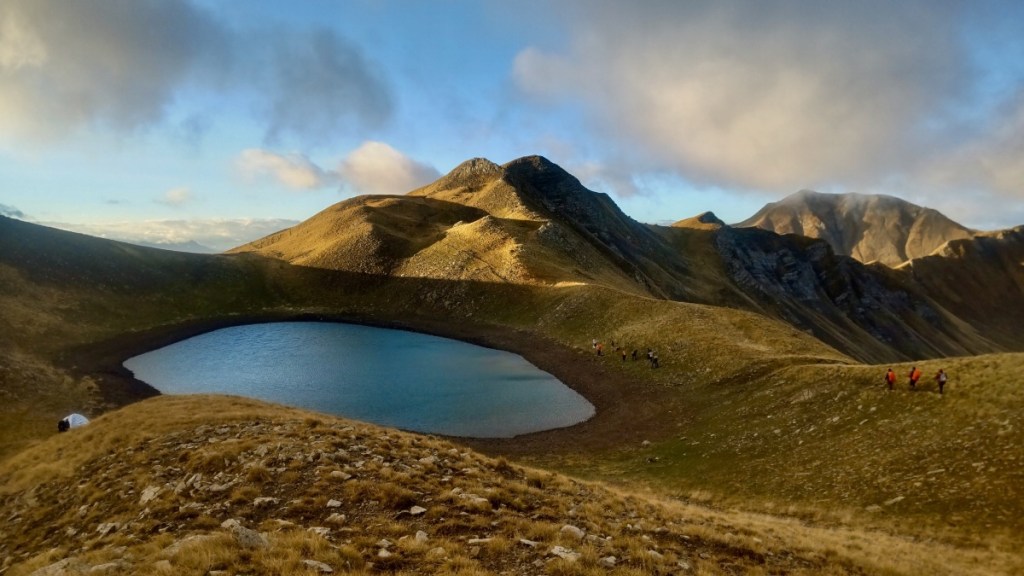
The name Grammos sounds a lot like the word grammi, which means line. And indeed, this namesake mountain range forms the very line that marks the border between Greece and Albania, stretching along its prickly ridge. Let’s head up north and explore one of Greece’s most magnificent and historically charged mountains.

To reach up to the north is no easy feat, even for a passenger, or even worse for a driver. I had to make myself remain patiently in an uncomfortable bus seat for the ten-hour trip from Athens to the border. The time passed with a mix of naps, pantomime, quizzes and never-ending gossip. On the way, we stopped at many excellent natural landmarks that you should definitely plan to visit: the holy rocks of Meteora (a climber’s paradise) and the serene lake Kastoria (known for its excellent vineyards).


Grammos is the fourth tallest mountain in Greece, standing at the northern end of the Pindus range. The summit of Tsuka Petsik, at 2,520 meters, offers an unobstructed view in all directions, a reward for those who make the climb. Other prominent peaks include Perifano, Diaselo and Arena, areas of great biodiversity and natural beauty. In order to make the long hike from Grammousta to the summit and back, we had to start early, before sunrise. At the beginning, we were short of an actual marked path, so we just followed the general direction to the summit. But as the sun started blessing the mountain valleys, the glistening lakes that I left behind me, were a mesmerizing sight to behold.


This mountain is also the birthplace of Greece’s largest river, the Aliakmonas, which begins its journey here, flowing through a rough landscape of gorges and waterfalls. At 2,350 meters, Lake Gistova stands out as a small but striking alpine lake. It’s a welcome treat for the eyes on the way to the higher peaks, a serene spot to pause. Lake Gistova, the most elevated natural lake in Greece, is home to a tiny population of newts, quietly inhabiting its chilly waters. Legend has it that a dragon once lived in the village below Grammos. Despite its fearsome appearance, the dragon was kind-hearted. Yet the villagers, uneasy with its presence, decided to drive it away. Heartbroken, the dragon retreated to the high peaks. Before leaving the village behind, it paused and shed a single tear of sorrow, which became the first small Drakolimni (Dragon Lake) of Moutsalia. Even this act of grief didn’t soften the villagers’ resolve. They continued to chase the dragon further, to a place where it could no longer see its beloved village. Devastated, the dragon cried once more, this time shedding a larger tear that formed the main Drakolimni of Gistova, far above and away from the village.


The view of the lake was excellent. The wind, however, had other plans. It was howling fiercely, nearly making me lose my balance. The biting cold, amplified by the humidity, seemed to pierce through my skin, leaving me shivering despite the effort of hiking. We were only halfway through the ascent, but I already felt miserably cold. As if to mock us, we spotted a pair of campers who had braved the night beside the lake. I couldn’t fathom how they endured the relentless sound of the wind. I was reminded of an essay about the mountains that remarked something like the following: “The reason people moved to the lowlands to survive the winter wasn’t the cold; it was the wind. Its harrowing voice could drive anyone mad.” Standing there, with the wind howling all around, it was impossible not to feel the truth of those words.


Grammos isn’t just about its natural splendor. The area holds a significant place in modern Greek history, particularly during the civil war (1946–1949). The mountain served as the last refuge for the Democratic Army of Greece (DSE), with its dense forests and hidden paths providing cover. A few terrible decisions were made by the then communist party, that left the resistance forces out of support from nearby Albania. This was the stage for the final battles of the conflict, were many brave men and women lost their lives, which eventually led to the disbandment of the DSE and the end of the civil war. Today, the marks of this chapter in history remain—old bunkers, provision trails, rusty ammunition boxes, the abandoned resistance hospital and commemorative sites scattered across the terrain.


But what about the villages of Grammos? Another legend said that the local spirit used to reside in the village of Aetomilitsa and kept the village from falling down. Then, three women stole it and brought it to Grammousta to help their village survive. That’s why Grammousta thrived and the nearby Aetomilitsa didn’t. This legend probably serves as an explanation of the hardships faced by villagers due to the many landslides.


Nevertheless, the spirit indeed blessed this specific crossroads of cultures, religions, languages and goods to be a thriving exchange hub, until its devastation by Ali Pasa of Ioannina in the 17th century. Then, the civil war broke the final straw. The village of Grammousta, once a thriving hub for the Vlach, Slavic, Sarakatsani, Muslim and Orthodox communities, now stands as a quieter place. These days, it’s little more than a handful of buildings: a tavern, a few guesthouses, a small military camp, and some scattered homes. There’s not much there, just the solitude of the borderlands. Its proximity to Albania adds another layer of character to the region, with cross-border movement a regular part of life for many, whether for work or family ties. The border itself is visible along the ridge, marked by discrete cement pyramids that run like a seam along the mountain.


The temperature in Grammos is always cold, with a yearly average of 9 degrees Celcius in Grammousta. The name of the peak Tsiouka Petsik originated like this. About a hundred years ago, a few shepherds made a bet that whoever could spend a winter on the peak in a stone hut would win a thousand sheep and a hundred cows. Only one shepherd, Pets (Petros), accepted the challenge. He stayed in the hut with all necessary supplies. As winter progressed, the harsh conditions and the constant roar of the wind made him regret his decision. By mid-February, he wrote a note saying he couldn’t endure the wind any longer and would die from its roar. In May, the other shepherds found him dead in the hut. Since then, the peak has been called Tsiouka Pets, to honor his commitment to the bet.


On our way back to Grammousta, we took trail, which for the most part following a dirt road. The return seemed endless, we walked and walked and walked. Other popular paths include the trails of Vlachostrata and Lianotopi and the serene paths around Lake Moutsalia (from the vlach word of ‘wet’) or Lake Arena (meaning ‘sandy shore’). The owner of the local tavern, Violeta, despite her rough manners, made sure to accommodate us. She seemed unable to comprehend vegetarianism as a concept, but still cooked an omellette for our friend. Later at night, proud of her husband being a true Sarakatsani, urged him to sing for us the old songs of Pindus, accompanied by a defi (tambourine).


Here is the trail from Grammousta to Tsouka Petsik and back on all trails. Once again, I am grateful to Utopia adventures for taking me along. You can read more hiking posts under the tag hiking. If you liked this article, share it with your friends. You can also follow this blog, and follow me on Instagram or Facebook, to never miss a post. Until next time!

Read more:

Hiking in Greece: The dragon lake of Tymfi
Today, I’m sharing my experience hiking in the Pindus Mountains and visiting the Dragon Lake of Tymfi. The…
Keep reading
Hiking in Greece: Smolikas finished second
First things come first, but the runner-up also has their charm. After Mt Olympus comes Mt Smolikas, the…
Keep reading
Malevos and Malevi
It’s funny how Mt Parnon is my home mountain, but I didn’t bother to prepare an article about…
Keep reading belleelene