
A friend of mine likes to tease me by pointing out that my hometown doesn’t have a fortress—just a humble watchtower. So, to balance the scales a bit, here’s a grander offering from the neighboring city: a fortress that is larger, more imposing, and far more impressive.

The Palamidi Fortress in Nafplio rises 216 meters above sea level, perched on a strategic hill that commands a panoramic view of the surrounding region. Conceived by the Venetian commander-in-chief Morosini, it was designed by Swedish engineers and implemented under the supervision of Governor Grimani in 1711. The Venetians controlled many key port cities and islands in the region, since the 14th century. Ironically, just one year after its completion, the fortress was seized by the Ottoman Turks. Though it was considered impregnable, it fell due to betrayal by LaSalle, the engineer who had a hand in its design. Later, during the Greek War of Independence, revolutionaries managed to capture it by stealth: sneaking in on a rainy night and unlocking the gate from the inside.


Palamidi has eight bastions, which were given new names, each time the ruler of the fortress changed. After Greek independence, these were renamed after legendary ancient warriors like Leonidas and Miltiades. The bastion Miltiades was notoriously used as a prison during the turbulent years following the revolution. Among its most famous inmates was none other than General Theodoros Kolokotronis, the heroic leader of the Greek forces, who was charged with treason against the newly crowned king. This prison earned a grim reputation as the harshest and most ruthless in Greece and remained in use well into the 20th century.


To reach the fortress, one must climb a staircase of 999 steps. Legend has it that there was once a thousandth step, broken by Kolokotronis’ horse as he rode up to face imprisonment. I tried counting the steps myself once to verify the story, but quickly lost interest. Regardless, the effort is well worth it—the view over the Argolic Gulf and the city below. From there, you can also see the island-bound prison of Bourtzi, the Acronauplia fortress (the local acropolis), and the castle of Argos in the distance. If the climb seems daunting, there’s also a road that allows cars to reach the entrance.


The fortress takes its name from the mythological hero Palamedes, son of Nauplius, the legendary founder of the city beneath. Palamedes was known for his intellect and ingenuity. He is credited with inventing several Greek letters, as well as navigation, lighthouses, units of measurement, currency, and even the divisions of time—hours, days, and months—not to mention board games. Although he doesn’t appear in Homer’s Iliad or Odyssey, he was a pivotal figure in the Trojan War. He was the one who outwitted Odysseus, forcing him to honor his oath and join the war to retrieve Helen. To feign madness, Odysseus began plowing a field with an ox and a donkey, sowing salt. Palamedes placed Odysseus’ infant son in the path of the plow. Odysseus stopped working to avoid harming the child, thus revealing his sanity. This caused a grudge between the two to form, leading Odysseus to orchestrate Palamedes’ downfall—arranging his death either through stoning after slandering him for treason, or by drowning him. The vendetta continued, when his father, Nauplius, sought to destroy the returning Greeks, luring their ships to wreck on jagged shores by lighting false beacons and seducing their wives (see Agamemnon and Klytemnistra).


Some dozen kilometers away, the Venetians built another -much smaller- fortress to safeguard the region: the Castle of Estella in Paralio Astros. They also constructed another stronghold with the same name in the nearby Parnon mountain, now known as the Castle of Oria, to monitor the unruly tribe of Tsakones. Like Palamidi, it too fell into Ottoman hands, who reinforced it to withstand recapture attempts by either the Venetians or local rebels.


Eventually, the Zafeiropoulos family—wealthy merchants who had returned from abroad—took control of the castle and significantly expanded it. It was at this stronghold that the Greeks achieved a major victory over Ibrahim Pasha, an event that greatly boosted morale during the revolution. From up there, one can marvel at the views of Mount Parnon, Mount Zavitsa, and the entire Argolic Gulf stretching toward the islands of Hydra and Spetses.


In spring, tall shrubs and wildflowers cover up the space, so that you can’t notice the structure anymore. Even the east tower is obscured by nature’s enthusiasm. During the summer, however, the castle grounds are trimmed and cleared up, in order to accommodate occasional concerts which are held up there, under the August moon. The most instagrammable location is the window of what’s left of the first-born Zafeiropoulos’ house, overlooking the port town of Paralio Astros.


Finally, I’ll take you to a solitary tower—what remains of a once-functional windmill. On the beach of the village of Agios Andreas, a crumbling structure now gradually sinks into the sea. Originally owned by a businessman from the island of Syros, the windmill was used to grind mastic shrubs for producing textile dyes. It is not currently being preserved, so locals make the most of it while it lasts. It used to be a pleasant spot for a swim, with the silhouette of the tower as a backdrop. If you continue walking north along the shore, you’ll arrive at Cheronisi beach and the borders of the Moustos Lagoon, a site of significant ecological value protected under the Natura 2000 network (on this note, remember to keep up with SaveParnonas).


You can also visit Palamidi fortress using a joint 3-day ticket of historical attractions in Argolis, such as Mycenae and Tyrinth. From Nauplio, or after climbing the great rocks in Leonidion, you can easily arrange a day trip to Estella castle in Paralio Astros and Mylos in Agios Andreas. You can also hike up Mt Parnon, Lepida gorge and the castle of Oria, or visit Loukou. Here you’ll find the relevant trails in Nauplion and Astros in alltrails. You can read more hiking posts under the tag hiking. If you liked this article, share it with your friends. You can also follow this blog, and follow me on Instagram or Facebook, to never miss a post. Until next time!


Read more:
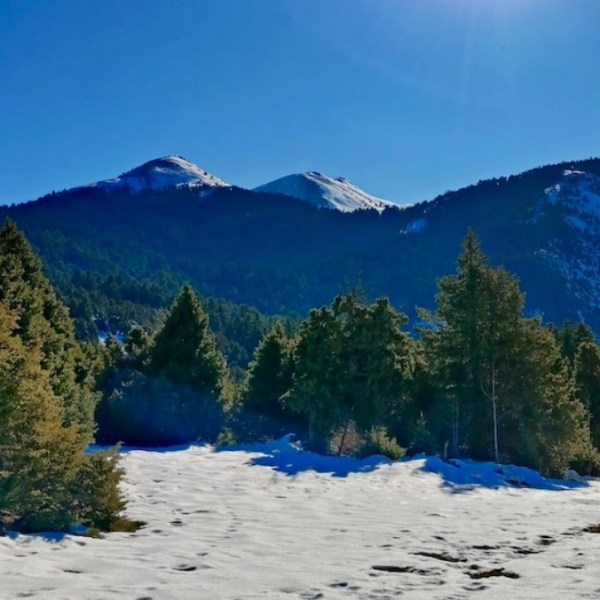
The plateau of Mt Parnonas
Have you ever failed to see a mountain? It might sound unbelievable, but it took me decades to…
Keep reading
Hiking in Greece: Lepida Gorge
In Greece, there’s a saying that goes, ‘If I don’t praise my house, it will fall on my…
Keep reading
Hiking in Greece: Herode’s villa at Loukou and the ancient Thyrea
Approximately a 2-hours drive from Athens, lies the small town of Astros. It is a seaside resort, especially…
Keep reading belleelene