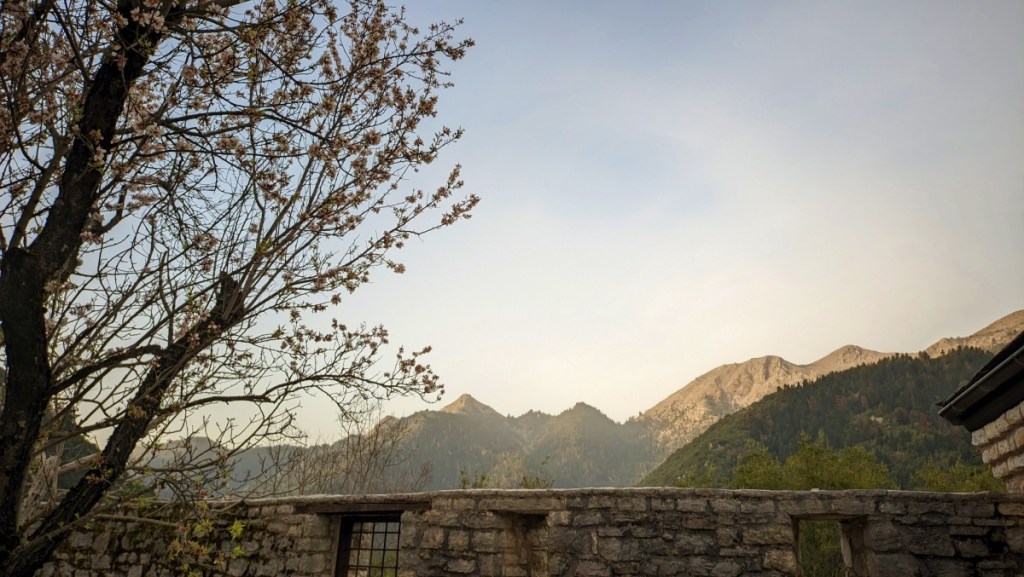
Lately, I’ve been reading Jitterbug Perfume by Tom Robbins. If you’ve come across it, you’ll know that the god Pan plays a rather central role—not just in the story, but in the broader question of what it means to be alive, wild, and human. That brought to mind my recent excursion to Mount Erymanthos, where Pan once wandered, possibly barefoot and half-laughing through the pine-scented air.

We start off at one of the villages built on the foot of the mountain, specifically Ano Vlassia. Mount Erymanthos rises to 2,224 metres at its peak, Olenos, making it the fourth highest mountain in the Peloponnese. It stretches across the regions of Achaea, Elis, and Arcadia, forming a natural boundary that in older times marked tribal lands and ancient crossings. The modern village of Tripotama sits at the junction of these three, its name meaning, quite straightforwardly, “Three Rivers.” According to myth, Erymanthos was named after a son of King Lycaon (my great-great-great-grandpa from my grandma’s lineage hehe). Erymanthos the person went on to found Psophis, while Olenos (the mountain’s highest peak) owes its name to another mythical figure, a son of Zeus and one of the fifty Danaids. It seems even the stones up here carry family legacies. Anyway, this was sacred ground to Artemis, goddess of the hunt, and to Pan, who thrived in these wild slopes (why does it suddenly smell like goat here?). Many of the peaks of Erymanthos have names related to cutting utensils, like Lepidas (meaning blade) and Maxairas (meaning knife). A curious detail, if you’re into naming patterns—or happen to be carrying a swiss army knife.


Much of Arcadia’s mythos lives on in these woods and cliffs. Lycaon had a beautiful daughter, Callisto. Guess what, Zeus decided to court her, and she had to face the unsolicited consequences of Hera’s wrath. In order to protect her, Zeus transformed her into a bear with human brains. When the seed of their love, the young king Arkas almost killed his mother while hunting on Erymanthus, Zeus decided to intervene. He transformed Arkas into a bear cub and the large mammals recognized each other. However, in order to escape the omnipresent wrath of Hera, the king of gods decided to turn both bear mom and bear cub into constellations, Ursa major and Ursa minor.


Perhaps the most famous myth associated with Erymanthos is the Fourth Labour of Heracles: capturing the Erymanthian Boar. This fearsome creature lived in the forested slopes and terrorized the surrounding lands. Heracles captured it alive by driving it into the deep snow of the mountain, showcasing both his strength and cunning. A less familiar myth involves the goddess Aphrodite. A hunter named Erymanthos (yes, another one) happened upon her bathing with Adonis, her lover. She didn’t take it well and struck him blind. But, as these stories often go, he turned out to be Apollo’s son. In a twist of mythic irony, Apollo transformed him into the boar that eventually killed Adonis. Bummer.

Although the path we followed from Ano Vlasia towards Agrabella was supposed to be part of the European E4, it looked abandoned. Many parts of the trail where reclaimed by nature, bridges were broken, and rocks and trees were blocking access. For a while, we had to climb down the rocky course of a dry stream. We spent the night at the old Poretsos Monastery, which has been converted into a hikers’ hostel. It’s no longer a working monastery, but it holds its silence well. The monastery seams perfectly hidden away behind the mountain. During both the Greek War of Independence and World War II, many found refuge in these highlands. If you have the time, consider visiting the massacre site of Kalavryta, which serves as a reminder of more recent tragedy under the Nazi occupation of Greece.


On the next day we headed to a new adventure. To the east of Erymanthos lie the Lampeia Mountains, considered by many an extension of the Erymanthos massif. Their highest point is Mount Analipsi at 1,795 metres. The name “Lampeia” is said to come from the way sunlight reflects on the bare rock. In antiquity, the region was home to the city of Lampeia, which in time became known as Divri. The name it holds today, although at some point Lampeia resurfaced, alas for reasons of national pride.


Compared to Erymanthos, Lampeia feels like the definition of a rocky mountain. To the west stretches the Foloi Oak Forest, the largest of its kind in the Balkans, and a rare ecosystem in its own right. According to myth, the centaur Pholos once lived here—the one who politely hosted Heracles during his hunt of the Erymanthian boar. Pholos was one of the only two good centaurs, along with Chiron, the rest of them being a gang of barbaric half human-half horse bandits. Unfortunately, his good manners didn’t save him: offering Heracles a sip of fragrant wine attracted a rowdy gang of centaurs, and in the chaos, Pholos was fatally wounded after handling one of Heracles’ famously poisoned arrows.


Despite the weight of myth and memory, this part of the Peloponnese remains largely overlooked by both Greek and international hikers. That’s part of its charm. Ancient trails still thread through the firs and over the rocks, springs flow quietly beside half-forgotten chapels. Please, handle these mountains with care.


Here you’ll find the relevant trail recordings from Ano Vlasia to Agrabella on Erymanthos and to the peak of Lampeia Mountains. As always, many thanks to Utopia adventures for showing me the way. You can read more hiking posts under the tag hiking. If you liked this article, share it with your friends. You can also follow this blog, and follow me on Instagram or Facebook, to never miss a post. Until next time!


Read more:
My sufferings aged like snow on Helmos
It’s October, yet somehow a wildfire is crackling away in western Corinth, just a stone’s throw from the…
Keep reading
Hiking in Greece: Hermes playground at Mt Ziria
The Ziria mountain range is home to the second tallest peak of the Peloponnese. Taygetus is first, Ziria…
Keep reading
Hiking in Greece: Mt Taygetus
Standing at a balcony observing the north face of Mount Taygetos, I felt ancient whispers calling me to…
Keep reading belleelene