When spending time in Sofia, a mountain would always be nearby. Vitosha is just next door. No, not that Vitosha, not Sofia’s main boulevard with the tourists and the overpriced shops. I’m talking about Mt Vitosha, hear me out.

After an unbearably long period of time, I managed to meetup with my old roommate in Tokyo again. Since Bulgaria is just next door to Greece, I figured I’d spend a few days there. Apparently, you never run out of the mountain atmosphere when living in the capital, Sofia. Mt Vitosha (Витоша in Cyrillic alphabet) is a prominent 2,290 m mountain near Sofia, the capital of Bulgaria. The tallest peak is called Cherni Vrah, which translates to Black Peak. The Romans used to call it Scomius. It is a solitary mountain at the western part of the country, in between the two ranges that define Bulgaria; Rhodope and Balkan. The former forms the border to Greece, while the latter the border to Romania. Balkan is also known as Stara Planina in Bulgarian. A few other words that I’ve learnt and might come in handy: gora is the forest and planina is the mountain. Thus, Stara Planina means ‘old mountain’.

In ancient Greece, the Balkan used to be known as Haemus, which currently refers to one of the mountains of the planet Mars. A possible origin for the Haemus would be from the Greek word for blood. Legend has it that here Zeus injured Typhon, spilling his blood on the mountains and thus naming them. Such an important battlefield, thus the Balkan mountain range eventually lent its name to the entire peninsula. Another folk tradition mentions that Haemus and Rhodope were the children of a sea god. In their carefree childhood, they once mocked the old gods—Haemus with a long white beard and Rhodope with her blond hair. This act enraged the old gods, who transformed Rhodope into a curvaceous mountain and turned Haemus into a severe, mannish mountain. To further punish them, he separated the two with the vast Thracian Plain. But enough about the Balkan, we are talking about Vitosha today.

The mountain’s proximity to Sofia makes it a popular destination for both locals and tourists. Indeed, most of the people that I met hiking in late May, seemed to be tourists. Vitosha was designated as a national park in 1934, making it the oldest national park in the Balkans. The landscape is dominated by forests of spruce, fir, and pine, interspersed with meadows and subalpine zones. Wildlife on the mountain includes deer, wild boars, foxes, and a variety of bird species (no bears – lucky!). Bulgaria’s longest cave, Duhlata, is situated in at Vitosha and stretches for whooping 18,200 meters. A meteorological station was built at the summit in 1935, still functioning today as a shelter for hikers and the mountain rescue team’s headquarters.

Vitosha is a year-round destination offering a wide range of activities. In summer, visitors can enjoy hiking, mountain biking, and rock climbing. In winter, the mountain transforms into a hub for skiing and snowboarding, with Aleko being one of the main ski areas. As a result of its year-round charm, the mountain is easily reachable from Sofia via public transport, including lifts and cable cars. However, the lift operates mostly during weekends and may be closed for maintenance for a few months from time to time. How do I know? I managed to visit exactly on a weekday that it was out of order for repairs.


With the lift out of order and us starting our hike late, we decided to stroll down the mountain from the Golden Bridges (Zlatnite Mostove, Златните мостове). A bus takes you there, since it is a popular tourist attraction. It is a stone river, formed in the valley of Vladayska River by ancient glaciers and erosion. It descends from 1800 meters above sea level at Boeritsa Chalet to 1410 meters at the Golden Bridges. A recent storm had destroyed the landscape here and there, but it should be good by now. From this point, we entered the hiking path towards the Momina Skala hut.

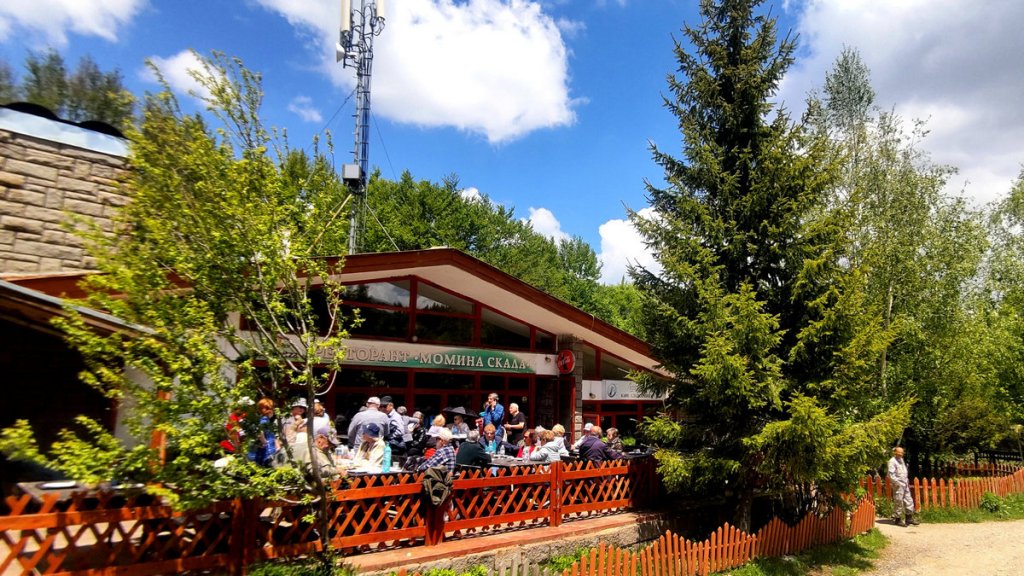
Momina skala translates to Maid’s Rock. The rock is named after a miraculous legend involving Paraskeva, the daughter of a local feudal lord. When Turkish armies invaded, she fled to the rock to save her life. Facing capture, she jumped into the abyss to preserve her honor. And that’s how the rock has gotten its name. I didn’t notice the rock, since all I could see was a spacious plain. A lot of people were enjoying the spring sun. A group of older people had picked up painting, while others were drinking and chatting at the benches.

Another legend involves two shepherds, Vita and Lyulin, desperately in love. They were leaving and working on different sides of the mountain and would sing and play music to each other from separate ridges. Despite never meeting in person, Vita rejected all other suitors, hoping to marry Lyulin, which angered her mother. In her rage, the mother cursed them both, turning Vita into the black stone of “Black Peak” of Mt Vitosha and Lyulin into the nearby Lyulin Mountain. But there’s one more legend. In one song, the Balkan Range asks Mount Vitosha if it is asleep. Vitosha replies that it is not asleep but tired because guests from the Pirin Mountain had burnt its green forest and roasted its lambs.

Here, we meet another river, Boyana (Бояна). The name most probably comes from the male Slavic name Boyan. The river springs from this mountain and flows all the way to the capital. First, it flows through the homonymous district of Boyana, then partially underground the city and finally merges with the Perlovska River near the National Palace of Culture. Its greatest feature is the 25m high waterfall that forms abruptly at the northern foothills of Vitosha. The waterfall looked amazing, cozy inside the lush greenery. But most interesting was the roaring sound of its fast-flowing waters, which could be heard from everywhere.


We reached a wooden bridge, which was swept away, so we didn’t manage to get to one of the observation points. The ground was slippery and the path full of signs that said to watch out. There are two paths to reach the waterfall, a direct and steep trail more suited for hiking up, and a winding trail to Boyana Lake, suited for hiking down. The short trail is extremely dangerous during the winter because it tends to freeze. From here we can observe the TV tower at Kopitoto, a landmark of Sofia’s skyline. A hotel with a terrace is located next to the tower, but opinions of the locals vary. Some consider it a terrible business ruining the nature park, while others would like it to have been working properly under different management.


Finally, we exited the trail reaching the quiet neighborhood of Boyana. We headed to Boyana church (Боянска църква), a byzantine medieval church built in several phases since the 11th century. The name that you have to remember is Sebastocrator Kaloyan, the patron who financed its construction. The different materials and architectures on the church, as new things were being built on top of the old ones, are easy to spot. The interior is covered by three layers of religious frescoes, with all three versions of a saints portrait being visible at some walls. These frescoes are considered the earliest example of Bulgarian art. In 1979, Boyana Church was inscribed as a UNESCO World Heritage Site due to its exceptional cultural and historical value.

If you want to visit Mt Vitosha, from the Golden Bridges you can either follow the same trail (Momina Skala Hut to Boyana waterfall and Boyana district) as me or the trail to the Black Peak. You can read more hiking posts under the tag hiking. If you liked this article, share it with your friends. You can also follow this blog, and follow me on Instagram or Facebook, to never miss a post. Until next time!

Read more:

Hiking in Greece: The many gorges of Samothraki
Last summer, I had the most amazing summer vacation experience: no electricity, no water, no cash, no internet,…
Keep reading
Hiking trip to Fukushima: Mt. Adatara
Mt Adatara (安達太良山) is a prominent volcanic peak, a bit closer to Fukushima city. Its name consists of…
Keep reading
Hiking in the dawn at Bali: Mt. Batur
[Visited on August 2019, Greek version follows] The island of Bali, Indonesia is home to a couple of…
Keep reading belleelene