
The north of Okinawa is wild, inaccessible and lonely. The last of the three kingdoms included the peninsula of Yanbaru. Today we’ll see pineapples, jungles and a little bit of Karate Kid.
Όλα τα άρθρα από το οδοιπορικό στην Οκινάβα

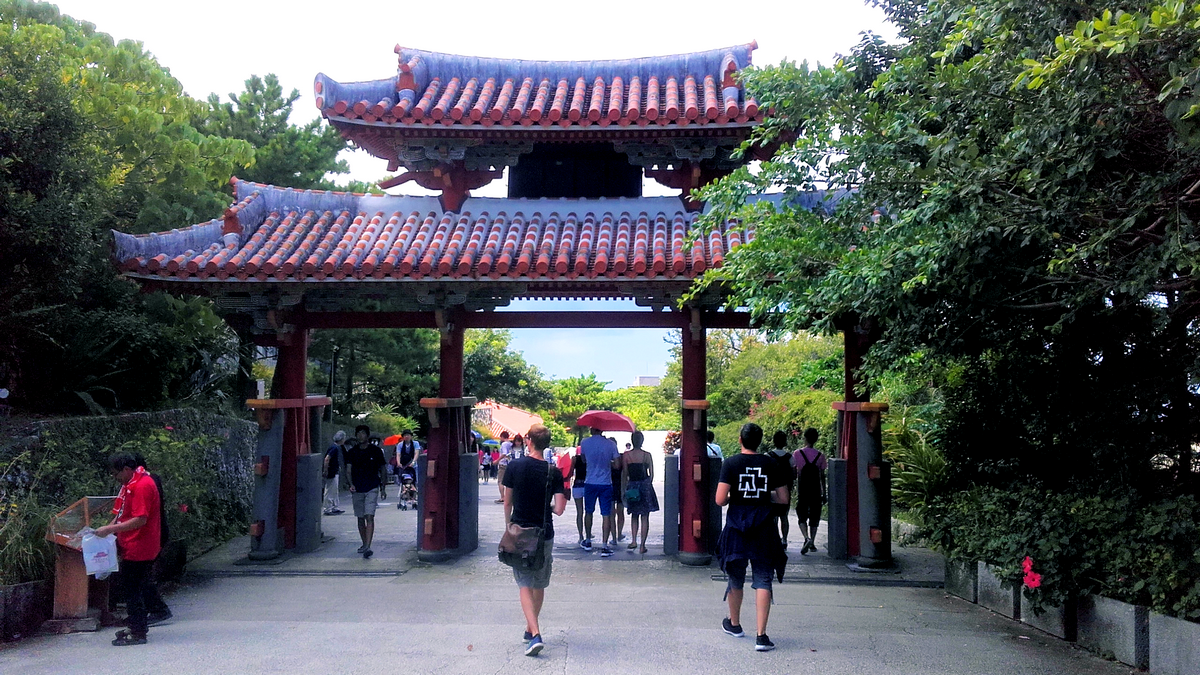

Okinawa has a sub-tropical climate, although to my untrained eyes it looks tropical with so many palm trees, colorful fish and fine sand (see: The climate of Japan [in Greek]). Its location allows the production of tropical fruits to thrive, such as pineapples, mangoes and lemon shikuwasa. It is a situation similar to Cretan avocados, although okinawan avocados have an even smaller production volume. In today’s globalized economy, it is cheaper to import pineapples from the Philippines and mangoes from Thailand, even though in theory Japan can produce them autonomously. Nevertheless, Okinawan producers are eager to promote the uniqueness of their own products, using all kinds of marketing tricks. The biggest project of Okinawa’s pineapple promotion campaign is Nago’s adorable pineapple park.


Nago is the largest town in the northern part of the island. To get there, you have to drive several hours parallel to the sea. After passing the large flower whale shark that indicates that the aquarium is nearby, you will soon arrive at the pineapple park. There, a tiny train awaits you, to take you from the entrance to the park area. The park is fully automated with very few (obvious) human employees. You don’t even have to walk, because after the train, you get on an open-top golfcart, which also doubles as a tour guide via a sound system. Did you expect to be able to drive it? Ha, shake the wheel all you want, it goes where it wants to go on its own – which makes perfect sense considering the park’s main visitors are young children.


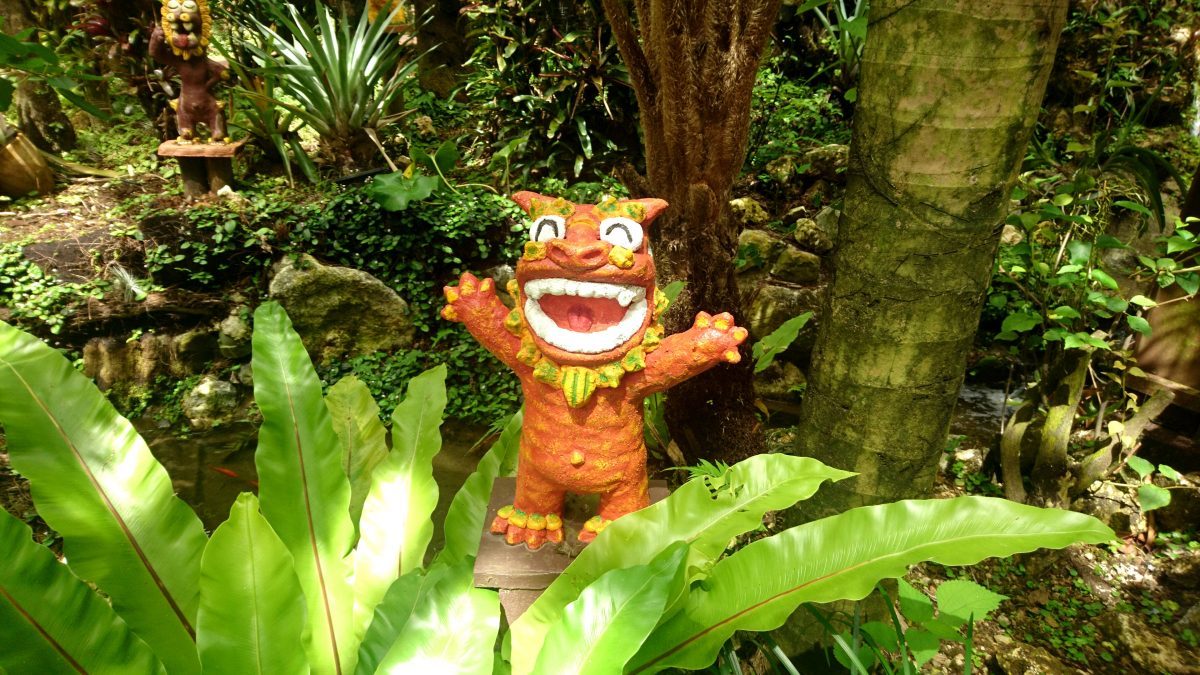
What I saw and impressed me most, was the evolution of a pinapple. Furthermore, I didn’t know that there were tiny pineapples popping out of the bushes. Also, it is striking to me that in their early form they have an identical structure with a yellow body and green bun, but they are just miniature. Pineapple cultivation in the islands is thought to have begun in 1866, when a passing Dutch ship brought back seeds. Did you know that there are over 2000 species of pineapple plants? Of these, about 100 are edible, and there are 126 different species in the park. The local variety of pineapple is called Smooth Cayenne. My favorite was the Hime-pine (姫パイン, meaning princess pineapple), which is not edible but is great for garden decoration. Aside from the bushes and the occasional pineapple statues, there are several other tropical trees and flowers on the tour. Among some of these are clustered pairs of shisha lions, and multiple Kijimuna elves (see: The legends of Okinawa [in Greek]). At the exit, a new entrance appeared, leading to a mini replica of Jurassic Park, complete with dinosaur effigies.


At the end of the tour, so that no one is left unsatisfied, in addition to the frozen pineapple slices and pineapple with chocolate, there is also a wine cellar. At the park they make local wine with an aftertaste of – what else – pineapple. In the souvenir shop (which is almost three shops in one), you’ll find all kinds of pineapple recipes, from edibles to cosmetics. The only thing missing was the guy in the leopard suit from the Pineapple Pen. I wonder if pineapple and pine-wine are the factors behind the famous longevity of Okinawans.


I also found coffee roasted in coral washed up by the sea, which of course I bought and found it delicious. The company is called 35 COFFEE, a pun between the word sango (珊瑚, coral) and the numbers 3 (san) and 5 (go). The company gives 35% of its profits to protect and replant corals on the Okinawa seabed.

Continuing further north, the rest of the attractions of the Yanbaru region are for fans of the 7th art. The movie Karate Kid is about the Okinawan style of karate (for which I’m still waiting for my friend Alexis to prepare a hell of an article explaining how it is superior to the other styles). In its modern sequel, Cobra Kai, Daniel visits the large island of Okinawa with his nemesis, Chozen, so he passes by two of Yanbaru’s most beautiful natural landscapes. The first is the Ogimi Village Observatory (六田原展望台), overlooking an archipelago of small islands. Besides the view, there is a very interesting abandoned building, a cafe with a balcony overlooking the sea and some hiking paths.


At the northern tip of the island, at Cape Hedo, there is a sacred site, the Daiseki Rinzan Cliffs (大石林山). It remains a sacred forest, named Ashimui (安須杜), since the Ryukyu Kingdom, and is full of shamanistic shrines. There are 4 paths through the forest, swirling between the imposing rock-forming figures. Some rock formations look like a camel, others like monkeys, others resemble the Lion King. In addition, there is a rock with an opening, where if you pass three times you have a good chance of reincarnation. Another one is in the shape of a human pelvis and is often visited by couples who want to have a child.


The most important formation is Goku-Iwa (悟空岩), the rock from which Goku, the monkey king from the classic Chinese story ‘Journey to the West’, sprang. Does the name Goku ring a bell? Yes, it’s the story on which the eponymous character in Dragon Ball is based.


Climbing up the side of Goku-Iwa, one ends up at an observation deck that overlooks Cape Hedo, from where the island of Yoron of the Amami archipelago can be seen when the weather is clear. The walking route ends up in a forest of Banyan trees, which are impressive because their branches and roots grow like stalactites. They look a bit like a hand from which honey is dripping. In the largest and oldest of these trees supposedly lives the mischievous elf Kijimuna. The scenery is truly beautiful and exudes a sense of calm and zen relaxation. This also seems to have an effect on the employees who work there, because I can’t remember ever having met kinder-hearted people in Japan.


Apart from the above, Yanbaru consists almost entirely of jungle and habu snakes. It has no beaches, but it does have some waterfalls accessible by trails. However, these are considered sacred and swimming is not allowed. Nevertheless, the drive alongside the coastline and among the wild trees and rocks, makes up for it. Yanbaru is not a place for tourists, it is a place for those who want to rediscover themselves in nature.
Tell me what you thought of the trip in the comments. If you liked this blog, spread the word to your friends. So you don’t miss any article, you can follow me on Facebook or instagram. See you next time!
Want to read more?

Μια μέρα στο βροχερό Λιχτενστάιν
Και πόσο να κάτσεις στη Ζυρίχη, κάποια στιγμή πλήττεις από την τόση τάξη και αλφαδιά. Το Λιχτενστάιν είναι…
Συνέχεια
Kakarditsa and Neraida: the endless meadows
It was late May when I got a phone call from my favourite mountaineering club. There was a…
Συνέχεια
Nisyros: For when you feel like stepping inside a crater
It was a casual Saturday night, and we were passing the time at an uneventful singles’ gathering by…
Συνέχεια
 belleelene